
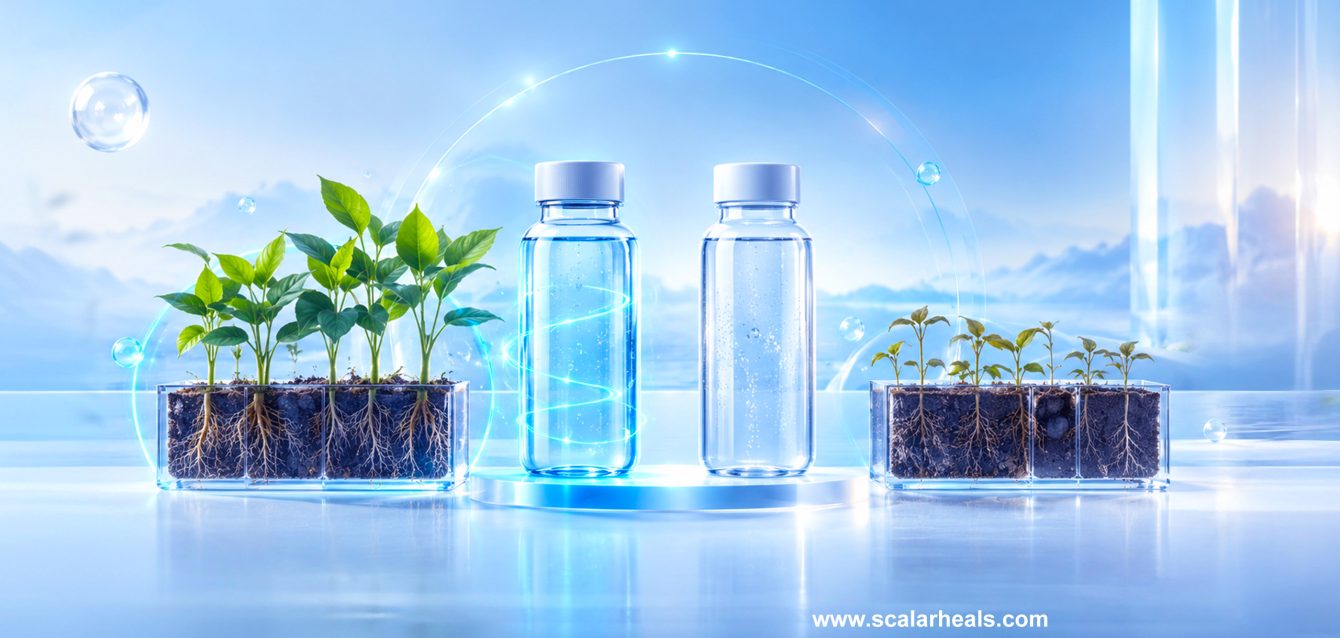
Two identical seedlings can begin at nearly the same height and look surprisingly different a month later. Was the water responsible, or did light, temperature, soil, and chance quietly shape the outcome? A 30-day plant growth experiment can help separate an interesting observation from a reliable comparison.
This experiment follows an earlier seed germination test but asks a longer-term question: after sprouting, do plants irrigated with scalar-charged water develop differently from plants given the same uncharged water? Published research more often examines water passed through a measurable magnetic field, which can inform the experimental design.
How the Controlled Plant Experiment Works
Seeds from one batch are germinated and randomly assigned to two groups with several pots in each group. The treatment group receives only scalar-charged water while the control group receives the same source water, handled and stored identically but without charging. Pot size, soil mass, seed variety, planting depth, water volume, watering time, light, temperature, and camera position remain constant. Rotating pot positions limits shelf or window bias, while coded labels allow measurements to be taken without knowing which group is which.
Record germination percentage and mean germination time during the first days. Then measure plant height twice weekly, count fully opened leaves, and photograph leaf area against a fixed grid. On Day 30, carefully wash the roots and record primary root length, total fresh mass, and, if possible, dry mass. Plotting each plant’s height over time reveals growth rate, not just which plant happened to be tallest at the finish.
What Would Count as a Result?
The comparison should use every plant, showing group averages and variation rather than a single eminent specimen. A consistent difference across replicated pots would justify repeating the experiment. Overlapping results would indicate no detectable effect under these conditions. Either outcome is useful.
In controlled wheat and lentil seedlings, magnetically treated water increased root elongation, while epicotyl length did not change significantly (Sestili et al., 2023). A tomato study reported faster germination and greater plant height with magnetically treated water, particularly under some salinity conditions, although responses varied with stress level (Samarah et al., 2021). Reviews likewise conclude that outcomes depend on plant species, water chemistry, field strength, flow rate, and exposure method (Alattar et al., 2022; Dobránszki, 2023).
And the most important finding is not whether one tray looks greener at the end of 30 days, but whether the full dataset shows a repeatable difference under controlled conditions and whether a second trial can reproduce it.
References
Alattar, E., Radwan, E., & Elwasife, K. (2022). Improvement in growth of plants under the effect of magnetized water. AIMS Biophysics, 9(4), 346–387. https://doi.org/10.3934/biophy.2022029
Dobránszki, J. (2023). From mystery to reality: Magnetized water to tackle the challenges of climate change and for cleaner agricultural production. Journal of Cleaner Production, 425, 139077. https://doi.org/10.1016/j.jclepro.2023.139077
Samarah, N. H., Bany Hani, M. M. I., & Makhadmeh, I. M. (2021). Effect of magnetic treatment of water or seeds on germination and productivity of tomato plants under salinity stress. Horticulturae, 7(8), 220. https://doi.org/10.3390/horticulturae7080220
Sestili, S., Platani, C., Palma, D., Dattoli, M. A., & Beleggia, R. (2023). Can the use of magnetized water affect the seedling development and the metabolite profiles of two different species: Lentil and durum wheat? Frontiers in Plant Science, 13, 1066088. https://doi.org/10.3389/fpls.2022.1066088