

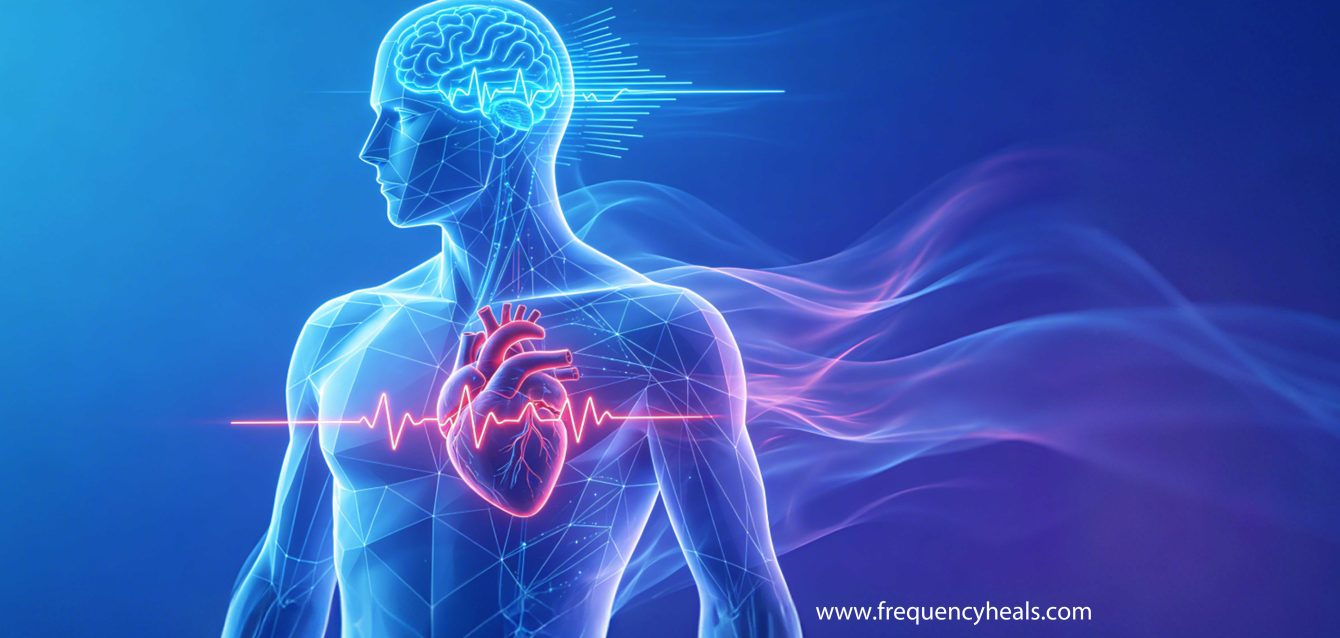
When people first hear about “frequency healing” or “therapeutic frequencies,” there’s often confusion about what frequency even means in the context of health and the human body. Frequency can sound abstract — like something external, technological, or artificial that needs to be introduced from outside.
But here’s what’s remarkable: frequency isn’t something foreign to your body. It’s what your body already is.
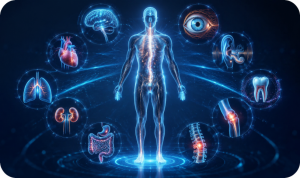
Every moment of your existence, countless processes within you pulse, oscillate, and repeat at specific, measurable rates. Your heartbeat cycles rhythmically. Your lungs expand and contract in steady patterns. Electrical waves ripple across your brain at various speeds. Hormones rise and fall throughout the day in predictable cycles. Your core temperature fluctuates on a 24-hour schedule. Even your emotional states can influence these biological rhythms, shaping the signals your body produces and responds to.
These aren’t random activities. They’re biological frequencies — repeating patterns that can be measured in cycles per second (Hertz), just like sound waves or electromagnetic fields. These natural rhythms are also part of why the body responds to rhythm and frequency in the first place. Understanding that your body already operates through frequency helps make sense of why external frequencies might influence your health and wellbeing. It’s not about introducing something alien. It’s about recognizing patterns that are already fundamental to how you function.
Your Heartbeat: The Most Familiar Biological Frequency
The most obvious biological frequency is the one you can feel pulsing in your chest and wrists — your heartbeat.
A healthy resting heart typically beats 60 to 100 times per minute, which translates to roughly 1 to 1.7 Hertz (cycles per second) [1][2]. This rhythm isn’t merely mechanical. It’s generated by specialized pacemaker cells in your heart’s sinoatrial node that create electrical impulses coordinating the contraction of heart muscle [1].
What’s particularly interesting is that your heartbeat isn’t rigidly constant. It exhibits what’s called heart rate variability (HRV) — natural fluctuations in the time intervals between consecutive beats [2][3]. Higher HRV generally indicates a healthy, adaptable cardiovascular system that can respond flexibly to changing demands. Lower HRV is associated with stress, fatigue, and reduced resilience [2][3].
Your heart rate also responds dynamically to other biological rhythms. During inhalation, your heart rate increases slightly. During exhalation, it decreases. This phenomenon, called respiratory sinus arrhythmia, creates a rhythmic coupling between breathing and heartbeat — two biological frequencies synchronizing naturally [2][3].
This isn’t just interesting physiology — it’s evidence of how biological frequencies interact and influence each other within your body constantly.
Your Breath: The Rhythm You Can Control
Breathing represents another fundamental biological frequency, typically cycling 12 to 20 times per minute in adults at rest — roughly 0.2 to 0.3 Hertz [2][3].
What makes breathing unique among biological frequencies is that it sits at the intersection of conscious and unconscious control. Your brainstem regulates breathing automatically without any thought, yet you can consciously alter your breathing pattern whenever you choose [3].
Research has identified what’s called the “resonant frequency” of breathing — a rate around 5.5 to 6 breaths per minute (approximately 0.1 Hz) where breathing optimally synchronizes with your cardiovascular system [2][3]. At this pace, the rhythmic fluctuations in heart rate driven by breathing reach maximum amplitude, engaging your baroreflex (blood pressure regulation system) most effectively and maximizing parasympathetic (calming) nervous system activity [2][3].
This is why slow, controlled breathing practices appear across virtually every contemplative tradition — they leverage the natural frequency relationship between breath and heart to influence nervous system states. It’s not mystical. It’s working with measurable biological frequencies that already exist within you.
Brainwaves: The Electrical Frequencies of Consciousness
Your brain generates perhaps the most fascinating biological frequencies — electrical oscillations measurable as brainwaves through electroencephalography (EEG).
These aren’t metaphorical waves. They’re actual electrical patterns created by synchronized firing of millions of neurons, oscillating at specific, measurable frequencies that correspond to different states of consciousness and brain function [4][5][6].
- Delta waves (0.5-4 Hz) represent the slowest brain oscillations, dominating during deep, dreamless sleep [4][5][6]. This frequency range is associated with physical restoration, tissue repair, immune system function, and the release of growth hormones. Delta is the body’s recovery mode — when your brain operates at these slow frequencies, your body focuses on healing and regeneration [4][6].
- Theta waves (4-8 Hz) appear during deep meditation, light sleep, and REM dream states [4][5][6]. Theta is linked to creativity, intuition, emotional processing, and memory consolidation. It represents a twilight state between waking and sleeping, where the subconscious becomes more accessible. Children naturally produce more theta activity than adults, which some researchers connect to their heightened imagination and learning capacity [4][5][6].
- Alpha waves (8-12 Hz) emerge when you close your eyes and relax while remaining awake [4][5][6]. Alpha represents relaxed alertness — you’re conscious and capable but not actively engaged in demanding tasks. This frequency range promotes mental resourcefulness, enhances the ability to mentally coordinate, and facilitates a calm, centered state. Alpha appears to bridge conscious and subconscious awareness [5][6].
- Interestingly, alpha waves peak around 10 Hz — a frequency that appears repeatedly in brain function as a kind of “idle speed” for the resting but awake brain [7]. Various brain regions produce 10 Hz rhythms spontaneously: the occipital cortex generates visual alpha, the precentral cortex produces the mu rhythm associated with motor rest, and the temporal regions create the tau rhythm [7]. This convergence on 10 Hz suggests it represents a fundamental natural frequency of neural organization.
- Beta waves (13-30 Hz) characterize your normal waking, thinking state [4][5][6]. When you’re alert, engaged in conversation, problem-solving, or actively processing information, beta frequencies dominate. This is your brain in working mode — attentive, analytical, making decisions. However, excessive beta activity, particularly in the higher ranges, is associated with anxiety and stress [4][5][6].
- Gamma waves (30-100+ Hz) represent the fastest brain oscillations, associated with peak cognitive functioning, heightened perception, and the binding of information across different brain regions into unified conscious experience [4][5][6]. Gamma appears during moments of insight, high-level information processing, and states of expanded awareness. Advanced meditators often show elevated gamma activity during deep meditation states [4][5].
- These frequency bands don’t exist in isolation — they all occur simultaneously in different brain regions, with different frequencies dominating depending on what you’re doing and how you’re feeling [4][5][6]. Your brain is constantly generating a complex symphony of electrical frequencies coordinating everything you think, feel, and do.
The 24-Hour Frequency: Circadian Rhythms
Beyond these faster rhythms operating on seconds-to-minutes timescales, your body operates on a fundamental 24-hour frequency — the circadian rhythm.
This isn’t just about feeling sleepy at night. Your circadian system is a master timing mechanism coordinating hundreds of physiological processes throughout your body [8][9]. Body temperature fluctuates on a 24-hour cycle, typically peaking in late afternoon and reaching its lowest point around 4-5 AM. Hormone levels rise and fall on circadian schedules — cortisol peaks in early morning, melatonin increases in evening, growth hormone releases during deep sleep [8][9].
Metabolism, digestion, immune function, blood pressure, cognitive performance, and mood all follow circadian patterns [8][9]. These rhythms are generated by a cluster of about 20,000 neurons in your brain’s suprachiasmatic nucleus (SCN) — your biological clock [8][9].
What makes this particularly interesting from a frequency perspective is that the SCN doesn’t just control one central rhythm. It coordinates “peripheral clocks” present in virtually every cell and organ throughout your body [8][9]. Your liver has its own clock timing metabolic processes. Your muscles have clocks coordinating repair and growth. Your gut has clocks regulating digestion. All of these distributed oscillators must stay synchronized with the central SCN clock and with each other for optimal function [8][9].
When these biological frequencies fall out of synchronization — through irregular sleep schedules, shift work, jet lag, or chronic circadian disruption — measurable health consequences emerge, including increased risk of metabolic disorders, cardiovascular problems, mood disturbances, and compromised immune function [8][9].
Hormonal Cycles: Slower Biological Frequencies
Beyond daily circadian rhythms, your body operates on even longer frequency cycles, particularly through hormonal oscillations.
Women experience approximately monthly cycles (28 days, or roughly 0.0004 Hz) through menstrual rhythms coordinated by complex hormonal interactions [10]. These cycles influence far more than reproduction — they affect mood, energy levels, cognition, pain sensitivity, and immune function throughout the monthly pattern.
Both men and women experience seasonal variations in hormone levels, mood, and behavior — rhythms operating on three-month to yearly timescales [10]. Cortisol levels, thyroid function, vitamin D production, and even cognitive performance show seasonal patterns in many individuals.
These slower frequencies demonstrate that biological rhythms span an enormous range — from gamma brainwaves cycling 40+ times per second to seasonal patterns cycling once per year, covering more than nine orders of magnitude in frequency.
Why This Matters: Your Body Speaks Frequency
Understanding that your body already operates through frequency fundamentally changes how you think about frequency-based wellness practices.
When someone suggests listening to specific audio frequencies to support sleep, they’re proposing synchronization with your brain’s natural delta frequency range (0.5-4 Hz) that already dominates during deep sleep. When frequency therapy targets stress reduction, it often works with alpha and theta ranges (4-13 Hz) that your brain naturally produces during relaxed states.
These approaches aren’t introducing something foreign. They’re offering patterns that match or complement biological frequencies already fundamental to your function. The question isn’t whether your body responds to frequency — it demonstrably does, since your body is built on frequency. The question is which external frequencies, delivered how, influence which internal biological frequencies in ways that support wellbeing.
Your heartbeat, breathing, brainwaves, circadian rhythms, and hormonal cycles aren’t separate systems — they’re interconnected frequencies constantly influencing each other. When your breathing slows, your heart rate responds. When light patterns shift, your circadian clock adjusts. When stress hormones rise, your brainwaves shift. You are a coordinated network of biological oscillations operating across multiple timescales simultaneously.
Frequency isn’t something abstract or external that needs to be added to your body from outside. Frequency is what you already are — a living, breathing, thinking, cycling collection of biological rhythms pulsing through every moment of your existence. Understanding this makes frequency healing comprehensible not as something mysterious but as working with the rhythmic nature that’s already defining how you function.
From the rapid oscillations of gamma brainwaves to the slow cycle of seasonal variations, from your heartbeat’s steady pulse to your breath’s controllable rhythm, you are — quite literally — a being built on frequency. And that fundamental reality is why external frequencies can potentially influence your health, support your wellbeing, and create the conditions where natural healing and balance can occur.
References
- [1] ScienceDirect. (2024). Biological rhythm overview.
- [2] Biology Insights. (2026). What is the best frequency for the human body?
- [3] PMC. (2024). The frequency architecture of brain and brain body oscillations: An analysis.
- [4] Calm Ripple. (2026). Different Hertz for healing: Natural frequencies for mind and body.
- [5] NeuroHealth Associates. (2024). The science of brainwaves – the language of the brain.
- [6] Meditation Music Library. List of all brainwave frequencies: A comprehensive guide.
- [7] PMC. The 10 Hz frequency: A fulcrum for transitional brain states.
- [8] National Institute of General Medical Sciences. (2025). Circadian rhythms.
- [9] Cleveland Clinic. (2024). Circadian rhythm: What it is, how it works & what affects it.
- [10] Frontiers in Sleep. (2025). Circadian rhythms revealed: Unraveling the genetic, physiological, and behavioral tapestry.







Comments
Want to learn the direction one after the other.
To know if the 369 can be connected to Christian believe
Hi Edward 💜
Thank you for your thoughtful question. 😊
The 369 is not specifically connected to Christian beliefs. People from many different backgrounds and faiths choose to listen to frequency audio as part of their personal wellness or meditation practice.
If you’d like to learn more about frequency healing and explore the topics step by step, you may find this guide helpful:
https://www.frequencyheals.com/your-frequency-journey/
Wishing you an enjoyable journey of learning and discovery. 💙✨
Could listening to certain frequencies help my mind to get back on a positive track? Ive had so much negative things happen to me this year. I cant seem to shake this energy. Its affecting every part of my life
Would like more info please
Hi Diane 💜
Thank you for your interest! 😊
If you’re new to frequency healing, a great place to start is our Your Frequency Journey guide. It explains the basics of how to get started, how to listen, and how to explore the different types of frequency audio we offer.
You can find it here:
🌿 https://www.frequencyheals.com/your-frequency-journey/
If you have any specific questions after reading, we’d be happy to help. Wishing you an enjoyable journey of discovery! 💙✨
I have neuropathy sciatica as well many med issues from birth n now w neuropathy n sciatica n fx hip i can hardly walk n think im slowly dying every day n need healing some way to get me in a better place for awedding comin up thanks
Hi Vicki 💜
Thank you for sharing your story with us. We’re truly sorry to hear about the challenges you’ve been facing, and we appreciate you reaching out to our community. 🙏
For sciatica and nerve wellness support, you may explore this frequency session:
🌿 Nerve Health Frequency for Sciatica, Neuropathy & Pain Support
https://www.frequencyheals.com/frequencies/nerve-health-frequency-for-sciatica-neuropathy-pain/
We hope this can be a supportive addition to your wellness routine. We recommend listening at a comfortable volume and finding a routine that feels right for you. 🎧
Since you mentioned difficulty walking and multiple health concerns, we also encourage you to continue working with a healthcare professional for proper support and guidance.
Thank you for trusting us and sharing your experience. We wish you comfort, strength, and all the best on your journey. 💙✨
I’d like to know more about frequencies and how they really work…
Hi Bryane 💜
Thank you for your interest in learning more about frequencies. 😊
If you’d like to understand the basics of how frequency sessions work and why people explore frequency wellness, these guides are a great place to start:
🌿 How Frequency Healing Works
https://www.frequencyheals.com/how-frequency-healing-works/
🌿 Your Frequency Journey
https://www.frequencyheals.com/your-frequency-journey/
These articles introduce concepts such as frequency, vibration, resonance, and different ways people explore frequency practices.
We hope you enjoy exploring and learning more. Welcome to the Frequency Heals community! 💙✨
Interesting, but nothing about healing frequencies..
Hi Eric 💜
Thank you for your feedback. 😊
We appreciate your interest in learning more about healing frequencies. The article you read introduces the concept of natural frequencies in the human body, and you can explore more about frequency healing here:
🌿 Discover Frequency Healing
https://www.frequencyheals.com/discover-frequency-healing/
You can also explore our frequency sessions and wellness resources in our Frequency Healing Library:
🎧 https://www.frequencyheals.com/healing-frequency-library/
We hope these resources help you learn more about how frequencies are explored in different wellness practices. 💙
Thank you for being part of the Frequency Heals community. ✨