

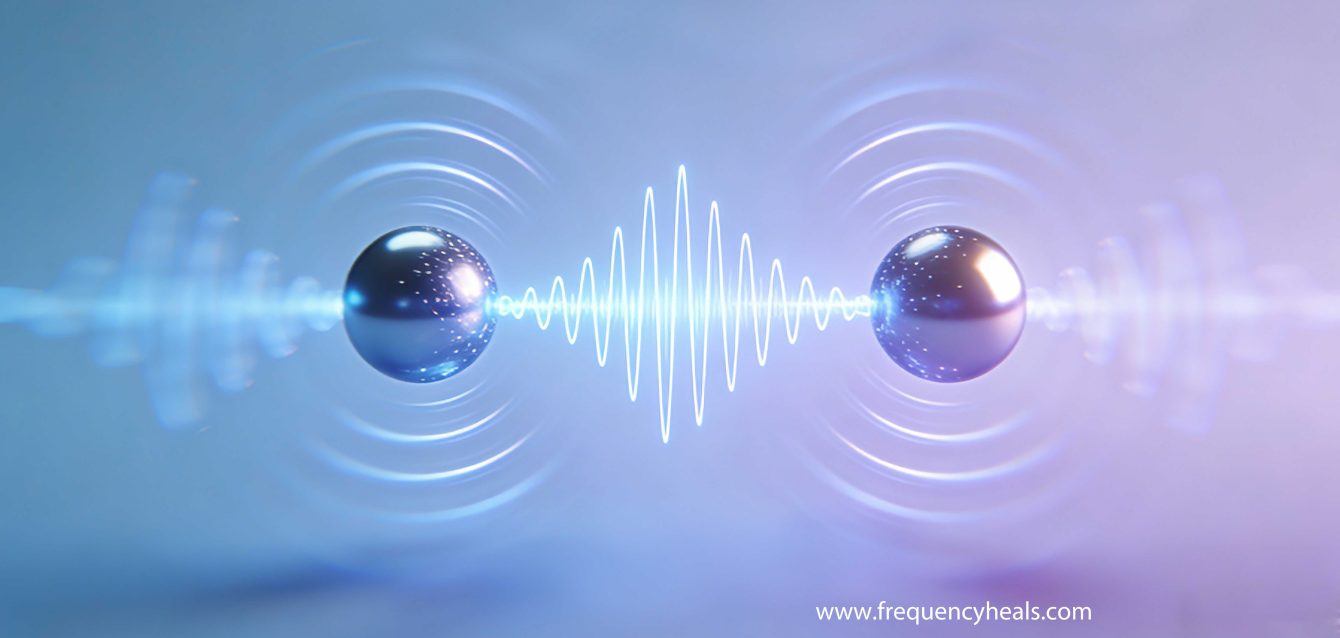
Some concepts in science feel abstract until the right example clicks into place — and then suddenly they’re everywhere. You see them in places you never noticed before. Resonance is one of those concepts.
Once you understand what resonance actually is, you start recognizing it in wine glasses and suspension bridges, in ocean tides and MRI machines, as well as countless examples throughout nature and everyday life. This connects with a broader idea explored in What Does Everything Is Vibration Mean: that repeating motion and oscillation are fundamental parts of the physical world around us. And — perhaps most interestingly for our purposes — in the way the human body responds to the world around it. Resonance also plays a role in how different systems can become coordinated and synchronized through shared patterns of vibration.
Let’s build the idea up slowly, starting from somewhere completely intuitive.
Everything Has a Natural Frequency
Pick up a rubber band and pluck it. It vibrates at a particular pitch. A tuning fork provides another simple demonstration of this same resonance principle, showing how objects respond most strongly at their natural frequencies. Stretch it tighter and pluck again — the pitch rises. A shorter, tighter string vibrates faster. A longer, looser one vibrates more slowly.
That preferred vibration rate — the speed at which an object naturally oscillates when disturbed — is called its natural frequency, or sometimes its resonant frequency. Every physical object has one. A wine glass, a bridge, a column of air inside a flute, a human vocal cord. They each have a characteristic frequency at which they vibrate most naturally and most freely.
The natural frequency is determined by the object’s physical properties: its mass, its stiffness, its shape, its material. Change any of those and the natural frequency shifts. This is why a cello string sounds different from a violin string, and why you can tune a guitar by changing the tension on each string.
So far, this is just basic physics. The interesting part begins when you ask: what happens when an external force pushes on the object at exactly that natural frequency? Even a small repeated force can create a surprisingly large response when resonance occurs, which is why small vibrations can sometimes have big effects.
When the Timing Is Right — Resonance
Imagine pushing a child on a swing. The swing has its own natural rhythm — a back-and-forth period determined by the length of the chains and the weight of the child. If you push in sync with that rhythm, adding a small nudge each time the swing reaches its peak, something efficient happens: the motion builds. Each small push adds to the previous one. Energy accumulates.
Now imagine pushing at the wrong time — when the swing is already coming back toward you. Your push works against the motion and disrupts it. Same force, completely different effect. What changed wasn’t the size of the input. What changed was its timing relative to the system’s own rhythm.
This is resonance in its most essential form: the phenomenon that occurs when an external oscillating force matches the natural frequency of a system, causing that system to absorb energy efficiently and oscillate with increasing amplitude [1].
Physicists measure this with a concept called the Q factor — roughly, how sharply a system resonates at its natural frequency. High-Q systems are very frequency-selective: they respond strongly to exactly their natural frequency and barely at all to anything slightly different. Low-Q systems are broader and less selective. Biological systems tend to be somewhere in between — responsive but not infinitely sharp, which makes sense for organisms that need to function in a noisy, variable environment [1].
Resonance in the Physical World — Examples That Make It Real
Before we bring this into the body, it helps to see resonance operating at a few different scales in the world around us.
The wine glass and the opera singer. You may have heard that a singer can shatter a wine glass with their voice. This is real — and it’s a perfect demonstration of resonance. Every wine glass has a natural resonant frequency, which you can hear when you tap it gently with a finger. If a singer produces a tone at exactly that frequency and sustains it at sufficient volume, the glass begins to vibrate at its own natural frequency. If the amplitude of vibration grows large enough, the glass exceeds its structural limits and breaks. The voice doesn’t need to be overwhelmingly loud — it just needs to be exactly the right frequency, sustained long enough [2].
The Tacoma Narrows Bridge. In 1940, a suspension bridge in Washington State collapsed spectacularly, not from overloading, but from resonance. Wind passing over the bridge created a periodic aerodynamic force that happened to match the bridge’s natural oscillatory frequency. The resulting resonant vibrations grew until the structure failed. Engineers now design bridges specifically to avoid this, incorporating damping mechanisms that prevent energy from building up at natural frequencies [1].
Ocean tides and the Bay of Fundy. The Bay of Fundy in Canada experiences the world’s highest tides — water rising and falling by up to sixteen meters. This is partly because the natural resonant period of water sloshing back and forth in the bay is approximately twelve and a half hours, which closely matches the roughly twelve-hour period of the tidal forcing from the Moon. The two rhythms are near-matched, so tidal energy accumulates in the bay far more than it does in most places [2].
MRI machines. Magnetic resonance imaging — MRI — uses resonance in a very direct way. Hydrogen atoms in the body have a natural frequency at which they absorb and re-emit electromagnetic energy (called the Larmor frequency). MRI machines apply radio waves at precisely that frequency. The hydrogen nuclei in tissue resonate with those waves, absorbing energy and then releasing it in a way that can be detected and mapped. The stunning images of soft tissue that MRI produces are, quite literally, images of resonance [3].
Resonance in Nature — the Living World
Resonance isn’t just a feature of human-made systems. It’s woven into living systems at every scale.
Sound localization in animals. Many animals use resonance principles to detect sound. The basilar membrane inside the mammalian cochlea — the spiral structure of the inner ear — is designed so that different regions respond to different frequencies. High-frequency sounds cause vibration near the base; low-frequency sounds travel further and vibrate the apex. This frequency-selective resonance is how your ear distinguishes a high violin note from a low cello note. The ear is, in a sense, a biological resonance detector [3].
Hummingbird wings and flower shape. Some flowers have evolved shapes whose mechanical resonance frequency matches the wingbeat frequency of their primary pollinators. When a bumblebee lands and vibrates at its characteristic frequency — a behavior called buzz pollination — the flower resonates and releases pollen more efficiently. The match isn’t accidental; it’s the result of co-evolution between two systems whose frequencies aligned over millions of years [4].
Circadian resonance with the environment. On a longer timescale, the approximately 24-hour period of the circadian rhythm is itself a kind of resonance — a biological oscillation that has been shaped by evolution to match the roughly 24-hour rotation of the Earth. Organisms whose internal clocks closely matched the external light-dark cycle had a survival advantage, because their physiology was synchronized to environmental conditions. The circadian system is not just a clock. It’s a biological resonance with the planet [5].
Resonance in the Human Body
By now, the relevance to the body is probably becoming clear. The human body is not a single resonating system — it’s an ensemble of them, operating at many different frequencies simultaneously.
The heart has a natural oscillatory frequency — typically somewhere around one cycle per second at rest, though this varies widely. The respiratory system oscillates more slowly, typically at around 0.2 to 0.3 Hz at a resting breath rate. When breathing is deliberately slowed to around 0.1 Hz — approximately five to six breaths per minute — something interesting happens: the respiratory frequency comes into resonance with the natural oscillation of blood pressure regulation (the so-called Mayer wave, at roughly 0.1 Hz). Heart rate variability reaches a maximum. The cardiovascular and respiratory systems fall into a kind of coherent synchrony [4].
This is what researchers call cardiovascular resonance frequency breathing, and it’s one of the better-studied examples of intentionally induced physiological resonance. It doesn’t require any technology — just deliberate, slow pacing of the breath. Yet the effects on autonomic nervous system balance and heart rate variability are measurable and reproducible [4].
At the cellular level, resonance principles appear in the behavior of voltage-gated ion channels — the proteins in cell membranes that open and close rhythmically to control the flow of ions. These channels have frequency-dependent behavior: they respond differently to stimuli at different frequencies, and at certain frequencies, their responses can amplify dramatically [3]. This frequency selectivity is part of how neurons are able to detect and encode rhythmic information in the world.
Even bones have resonant frequencies — a fact exploited by ultrasound bone stimulation devices used in clinical settings to accelerate fracture healing [1]. The mechanical resonance of bone tissue, when driven at appropriate frequencies, appears to stimulate the cellular processes involved in bone repair.
Why This Matters for Frequency-Based Practices
You can probably see where this is heading — and it’s a shorter logical step than it might initially seem.
If the body’s systems have natural frequencies, and if those systems can respond selectively and powerfully to external stimuli at matching frequencies, then the concept of intentionally introducing frequencies to interact with specific biological systems isn’t scientifically absurd. It’s actually consistent with well-established physics and biology.
The questions worth asking aren’t whether resonance is real — it clearly is — but rather more specific ones. Which biological systems have frequencies that are accessible to external influence? What modes of delivery are effective? At what intensities and durations? And which specific health-related outcomes can be reliably shifted through this kind of approach?
These are the questions that separate well-designed research from speculation. And they’re the questions that the better corners of the frequency healing field are beginning to engage with seriously [5].
It’s also worth noting what resonance is not. It’s not a magic amplifier that makes any tiny input infinitely powerful. Real resonating systems have damping — internal friction that dissipates energy and prevents runaway amplification. The body is heavily damped, which is a good thing: it means external frequencies don’t destabilize the system easily, but it also means that producing meaningful biological effects requires sustained, appropriately targeted input rather than brief or casual exposure [1].
Sitting with the Concept
I find resonance genuinely beautiful as a concept — not in a mystical way, but in the way that good physics often is. It describes something real and measurable, and yet it has this quality of… rightness about it. The idea that the universe is organized in ways that reward timing over brute force. That a small, well-placed input at exactly the right frequency can move something a large, mistimed force cannot.
The body, it turns out, is built on this same logic. Its systems are frequency-selective. They respond differently to different rhythms. And understanding that is genuinely useful — both as a framework for thinking about health, and as a foundation for evaluating the growing number of practices and technologies that aim to work with those frequencies intentionally.
In the articles ahead, we’ll start looking at specific applications — how this plays out in the context of sound therapy, PEMF, and other frequency-based approaches — with the same honest, curious lens we’ve been using throughout this series.
References
- [1] French, A. P. (1971). Vibrations and Waves. W. W. Norton & Company. [Classic undergraduate physics text on resonance, damping, and oscillating systems]
- [2] Acoustic Society of America. (2005). The physics of resonance and the breaking of glass by sound. Journal of the Acoustical Society of America, 117(6), 3524–3527.
- [3] Kandel, E. R., Schwartz, J. H., Jessell, T. M., Siegelbaum, S. A., & Hudspeth, A. J. (2012). Principles of Neural Science (5th ed.). McGraw-Hill. [Chapters on cochlear mechanics and ion channel frequency dependence]
- [4] Lehrer, P. M., & Gevirtz, R. (2014). Heart rate variability biofeedback: How and why does it work? Frontiers in Psychology, 5, 756.
- [5] Bhattacharya, J., & Bhattacharya, S. (2021). Listening to music in the light of resonance: A computational perspective. Frontiers in Psychology, 12, 638820.






Comments
Always intrigued by sound and frequency when I was younger I was always astonished about the radio and all aspects of sound and music
That’s wonderful, James 🌿 many people who become interested in frequencies say they first felt that same sense of curiosity through music, radio, resonance, and the invisible ways sound can affect mood and perception.
There’s definitely something fascinating about how vibration and frequency appear throughout nature, technology, and the human experience. ✨
Nikola Tesla understood this dynamic exceptionally well and came up with a way to vary the energy of his inputs. I presented a discussion Paper to an Innovator Society: Tesla was an experimental scientist and he tested everything before applying:
MIANU Journal 2022 Journal-MIANU-SCIENCE-AND-PRACTICE-SAP-No.-1-1.pdf Page 7
(https://mianu.org/wp-content/uploads/2021/09/Journal-MIANU-SCIENCE-AND-PRACTICE-SAP-No.-1-1.pdf