If you’ve ever felt genuinely, deeply rested after a long walk in the woods — or noticed that a few nights of poor sleep can make everything feel harder, emotionally and physically — you’ve already experienced something that researchers have spent decades trying to put into precise language.
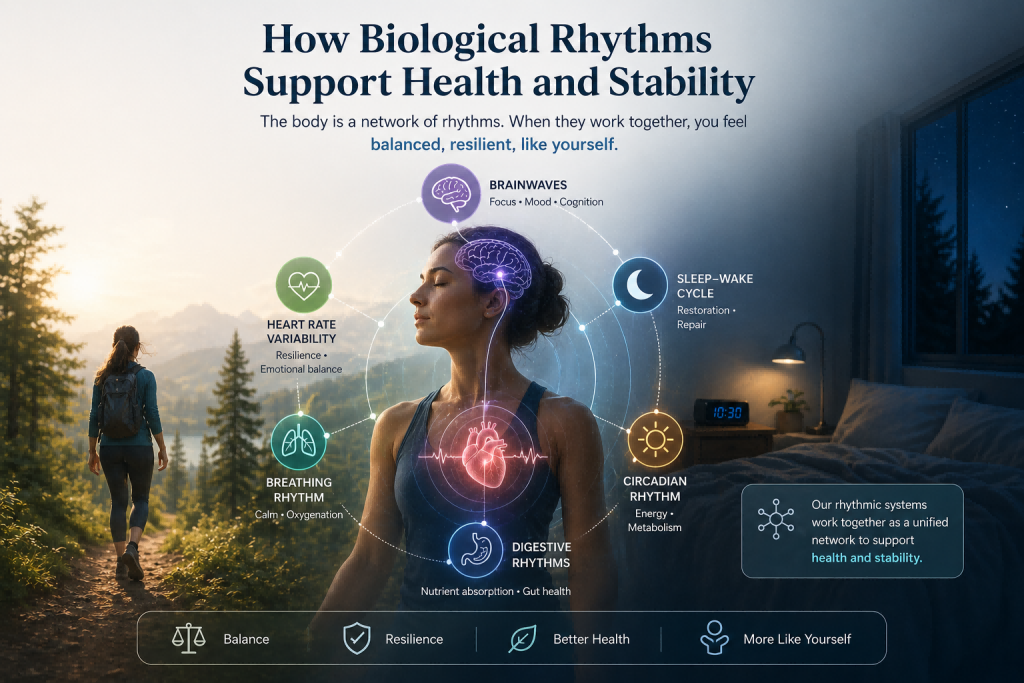
The body isn’t just a collection of organs doing their own thing. It’s a coordinated system of rhythms — and when those rhythms are working well together, something remarkable happens. You feel balanced. Resilient. Like yourself.
When they’re not… well. You probably know what that feels like too.
In the previous Why the Body Responds to Rhythm and Frequency article, we looked at how emotional states connect to the body’s rhythmic patterns — heartbeat, breathing, brainwave activity. Here, we’re going to zoom out and ask a bigger question: how do all of these rhythmic systems work together as a unified network to support health and stability? And what happens — both when that coordination breaks down, and when we actively support it?
The Body as an Orchestra
There’s a metaphor I keep coming back to: the body as an orchestra.
Each section — strings, woodwinds, brass, percussion — has its own part to play. Each operates on its own timing. But when the performance works, it’s because all those separate rhythms are coordinated into something coherent. The whole is unmistakably greater than the sum of its parts.
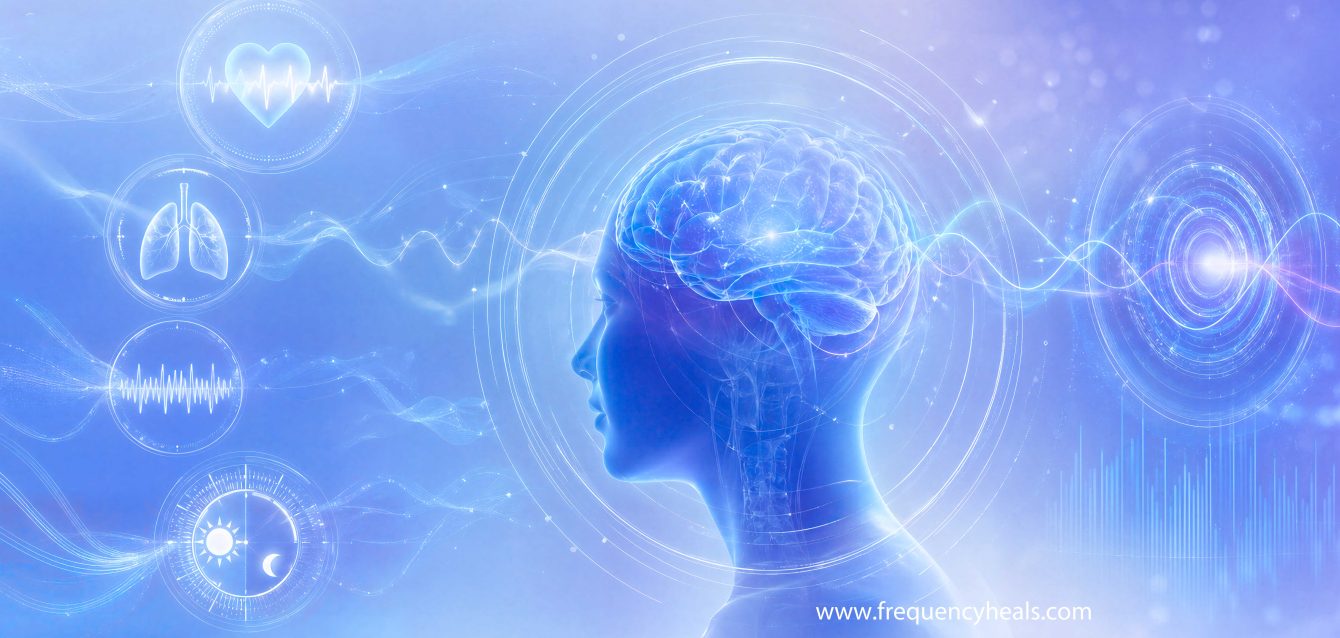
Your body’s rhythmic systems are a little like this. You have your cardiovascular rhythm — the steady, responsive pulse of the heart. Your respiratory rhythm — the slower, deeper wave of the breath. Your brainwave activity — cycling through different frequencies depending on your state of alertness or rest. And your circadian rhythm — the roughly 24-hour biological clock that governs sleep, hormone release, metabolism, and much more.
Individually, each of these is impressive. But the magic is in how they interact — and that interaction is far more active and structured than most people realize.
How These Systems Actually Talk to Each Other
The heart, breath, brain, and circadian clock aren’t just running in parallel. They’re in continuous, bidirectional communication through a network that includes the autonomic nervous system, the vagus nerve, hormonal signaling, and neural feedback loops.
Take the heart and breath as a starting point. Every time you inhale, your heart rate naturally speeds up slightly. Every time you exhale, it slows down again. This moment-to-moment variation — called respiratory sinus arrhythmia — is actually a sign of a healthy, responsive nervous system [1]. The breath is directly modulating the heart’s rhythm through the vagus nerve, which carries signals between the brain, heart, lungs, and digestive system.
Now layer in the brain. The autonomic nervous system — which governs both heart rate and breathing — is itself regulated by higher brain structures, including the prefrontal cortex and the amygdala. This means your emotional and cognitive state is constantly feeding into those rhythms from above, while the rhythms of the heart and breath are sending signals back up to the brain [2]. It’s a loop, not a one-way street.
The circadian system adds another dimension. Your master biological clock — housed in a tiny region of the hypothalamus called the suprachiasmatic nucleus — doesn’t just govern sleep timing. It coordinates the rhythmic release of cortisol, adrenaline, insulin, and melatonin, all of which influence heart rate, blood pressure, neural excitability, and respiratory patterns across the day. Circadian disruption doesn’t just make you tired — it subtly destabilizes the timing signals that the entire regulatory network depends on [3].
What you end up with is something researchers call a coupled oscillator system. Each rhythmic subsystem has its own natural frequency, but they’re loosely synchronized through shared neural and hormonal pathways. When the coupling is strong and coherent, the systems reinforce each other’s stability. When one falls out of step — through stress, poor sleep, or chronic dysregulation — it introduces noise into the whole network [1].
That’s the unified picture. And it’s why addressing just one rhythm in isolation often isn’t enough — the systems are too interconnected for that.
Physiological Coherence: When the Network Hums
Scientists use the term physiological coherence — sometimes called psychophysiological coherence — to describe the state in which these coupled systems are working in a coordinated, mutually reinforcing way [1].
In practice, coherence shows up in measurable ways. The heart’s rhythm becomes smooth and wave-like. Breathing and heart rate fall into natural synchrony. Brain activity tends toward calmer alpha frequencies. Stress hormones ease back. And crucially — the body’s capacity to self-regulate improves. It becomes more adaptive, more resilient [1].
Researchers at the HeartMath Institute have done substantial work documenting this state and its relationship to emotional wellbeing, cognitive performance, and immune function [1]. The science is still evolving, but the core finding — that coordinated rhythmic activity across systems is functionally different from uncoordinated activity — is well-supported.
What Disruption Actually Feels Like
You don’t need a research paper to tell you what it feels like when your body’s rhythms are off. Most of us have experienced it in smaller and larger ways.
A few nights of poor sleep and you’re more emotionally reactive — things that wouldn’t normally bother you start to feel genuinely upsetting. Your focus scatters. Your body feels heavier, duller. Even small decisions become effortful.
Chronic stress does something similar but more insidious. It pushes the nervous system toward sustained sympathetic activation — the fight-or-flight state — and over time, this flattens heart rate variability, disturbs sleep architecture, disrupts hormonal rhythms, and creates a kind of physiological dysregulation that tends to reinforce itself [2]. The coupled oscillator network loses coherence. Each system starts drifting, and the network as a whole becomes less stable.
This is the thing that often gets missed when we talk about stress or burnout: we tend to frame it as a psychological problem. But there’s a very real physiological dimension — one that involves the body’s rhythmic regulatory network being pulled out of its natural coordination.
Restoring Rhythm: What the Research Points To
The good news — and there is genuinely good news here — is that the body has a strong tendency toward self-regulation when given the right conditions.
Most of the well-evidenced approaches to stress, mood, and physical health turn out to work, at least in part, by restoring coherence to the rhythmic network. Regular physical exercise has well-documented effects on circadian rhythm stability, HRV, and autonomic balance [4]. Consistent sleep timing anchors the circadian clock and keeps its timing signals reliable. Morning light exposure strengthens the entrainment of the suprachiasmatic nucleus to the external day-night cycle.
Slow, paced breathing — which we explored in the previous article — acts on the network directly: by extending the exhale and activating the vagus nerve, it strengthens the respiratory-cardiac coupling and shifts autonomic tone toward the parasympathetic branch. This ripples upward into brain activity and downward into hormonal patterns [2]. It’s one of the most direct and accessible ways to nudge the whole network toward coherence.
Where Frequency-Based Approaches Fit In — and How They Work
This brings us to a question that’s worth taking seriously: how do frequency-based practices — sound therapy, bioresonance, and related approaches — actually interact with the body’s rhythmic regulatory network? Not just what they are, but how the mechanism might work.
Let’s start with sound, because the research is most developed there.
The auditory system has unusually direct access to the autonomic nervous system. Sound doesn’t just land in the ears — it travels rapidly to deep brain structures including the amygdala, hypothalamus, and brainstem, all of which are central nodes in the regulatory network. This is why a sudden loud noise can instantly spike your heart rate, or why certain music can slow your breathing without you making any conscious effort.
Rhythmic auditory stimulation — steady, structured sound patterns — appears to work partly through a process called neural entrainment. When the brain is exposed to a consistent rhythmic signal, its oscillatory activity tends to synchronize to that signal’s frequency. This has been observed with binaural beats (where slightly different frequencies played in each ear create a perceived beat), rhythmic drumming, and isochronic tones [4]. The effect isn’t unlimited or automatic — it depends on attention, context, and individual variability — but it’s measurable and reproducible enough that researchers are taking it seriously as a tool for influencing autonomic and brainwave states.
The practical implication: a slow rhythmic sound in the range of six to ten cycles per second may nudge brainwave activity toward alpha frequencies, which are associated with the relaxed-alert state. A rhythm synchronized to an optimal breathing rate can gently encourage the breath to pace itself — and through that, modulate heart rate variability and vagal tone [2]. The sound isn’t overriding the body’s rhythms. It’s offering the nervous system a coherent external signal to orient toward — a kind of scaffold.
Bioresonance therapy works from a related but distinct premise. The core idea is that living cells and tissues generate measurable electromagnetic oscillations as part of normal physiological function, and that these oscillatory patterns can become disrupted under conditions of stress, illness, or dysregulation. Bioresonance devices typically measure the body’s own electrical signals and either feed them back in modified form or introduce specific corrective frequencies, with the aim of restoring more ordered oscillatory patterns [5].
The research on bioresonance is more preliminary than on sound therapy, and specific claims vary considerably in their evidence base. What makes it conceptually coherent with the broader picture we’ve been building — rather than just speculative — is the established fact that the body’s regulatory systems do operate through oscillatory, frequency-dependent signaling. The heart, neurons, and endocrine cells all communicate partly through rhythmic electrical and chemical signals. The question isn’t whether the body has frequencies — it clearly does. The question is whether externally introduced frequencies can reliably influence those internal patterns in clinically meaningful ways. That’s where more rigorous research is still needed [5].
What sound therapy and bioresonance share — and what connects them to the broader framework of rhythmic regulation — is the assumption that the body’s oscillatory systems are responsive to structured external input. Not passively, but as part of their normal adaptive functioning. If those systems are already designed to couple with each other and adjust to incoming signals, then offering them a well-chosen external rhythm isn’t strange at all. It’s working with the grain of the biology.
The Bigger Picture
Across these two articles, a coherent picture has been taking shape.
Your body runs on rhythms — heartbeat, breath, brainwaves, circadian cycles — and these aren’t separate systems running in parallel. They’re a unified regulatory network, actively communicating through neural, hormonal, and electrical pathways. When the network is well-coupled and coherent, the whole system is more stable, more adaptive, and more resilient. When it loses that coherence — through stress, poor sleep, emotional dysregulation — the effects ripple across every dimension of how you feel.
Frequency-based practices are one way of supporting that network — not by forcing it into a particular state, but by offering it coherent rhythmic input that the nervous system can use as a reference point. Some of these approaches are better researched than others, and it’s worth staying curious and honest about what the evidence actually shows.
As this series continues, we’ll look more closely at specific practices — what happens in the body during sound therapy sessions, what the research on bioresonance actually demonstrates, and how to think clearly about these approaches without either dismissing them or overclaiming.
For now, the most grounding thing to hold onto is this: your body is already doing something extraordinary. It’s keeping time — across dozens of interlocking rhythmic systems, constantly adapting, constantly recalibrating. That’s not a metaphor. That’s biology. And understanding it is the beginning of working with it.
References
- [1] McCraty, R., Atkinson, M., Tomasino, D., & Bradley, R. T. (2009). The coherent heart: Heart-brain interactions, psychophysiological coherence, and the emergence of system-wide order. Integral Review, 5(2), 10–115.
- [2] Shaffer, F., & Ginsberg, J. P. (2017). An overview of heart rate variability metrics and norms. Frontiers in Public Health, 5, 258.
- [3] Reppert, S. M., & Weaver, D. R. (2002). Coordination of circadian timing in mammals. Nature, 418(6901), 935–941.
- [4] Thaut, M. H., McIntosh, G. C., & Hoemberg, V. (2015). Neurobiological foundations of neurologic music therapy: Rhythmic entrainment and the motor system. Frontiers in Psychology, 5, 1185.
- [5] Besson, C., & Boschung, M. (2019). Bioresonance therapy: A narrative review of its application and mechanism. Journal of Alternative and Complementary Medicine, 25(6), 569–576.