

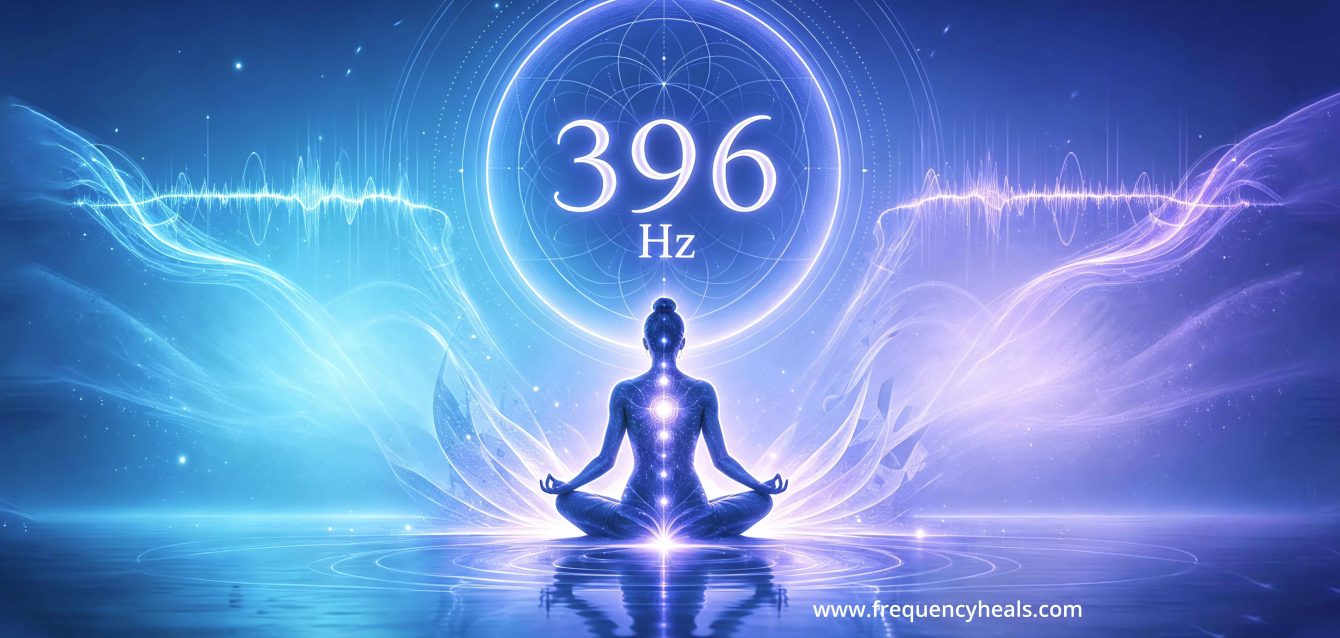
We all carry “invisible luggage.” It’s that heavy sensation in your chest after a long day, or the nagging voice of guilt from a past mistake. Sometimes, these emotions—fear, anxiety, and remorse—become so deeply rooted in our subconscious that they feel like a permanent part of our identity.
But what if you could “unplug” from these negative loops using the power of physics? 396 Hz is known as the frequency of liberation. As one of the core Solfeggio frequencies, it is specifically tuned to target the emotional blockages that keep us stagnant. Whether you are dealing with a stressful career or deep-seated trauma, 396 Hz acts as a vibrational “key” to unlock your emotional potential.
What is 396 Hz? The Frequency of Liberation
The 396 Hz tone belongs to the ancient Solfeggio scale, a series of frequencies used in Gregorian chants and Eastern traditions to harmonize the body and spirit. While 528 Hz is famous for “transformation,” 396 Hz is the essential first step: the clearing.
Technically, it is associated with the Root Chakra (Muladhara), which governs our sense of safety, security, and belonging. When this frequency resonates with our biofield, it helps “ground” our energy, making it much harder for fear and guilt to take root.
The Science Behind Emotional Release
It may sound like magic, but the impact of sound on emotion is grounded in neurobiology. Our brains are highly sensitive to external rhythms—a phenomenon known as neural entrainment.
- Regulating the Stress Response: Low-frequency sound stimulation has been shown to influence the autonomic nervous system, shifting us from the “fight or flight” sympathetic mode to the “rest and digest” parasympathetic state (Clements-Cortes & Bartel, 2018).
- Breaking the “Fear Loop”: Fear is often processed in the amygdala. Research suggests that stable, rhythmic auditory stimulation can help dampen hyper-reactivity in this brain region, allowing for better emotional regulation (Thoma et al., 2013).
- Vibrational “Cleaning”: Every emotion has a vibrational signature. Negative emotions like guilt resonate at lower, chaotic frequencies. By introducing a coherent 396 Hz tone, we encourage the body’s cells and the mind’s thoughts to synchronize with a more stable, harmonious pattern (Bartel & Mosabbir, 2021).
Top Benefits of 396 Hz
- Releasing Guilt and Fear:It helps dismantle the subconscious beliefs that tell you that you “aren’t enough” or that you “should have done better.”
- Turning Grief into Joy:By providing a grounding foundation, it allows the heart to process loss without becoming overwhelmed by it.
- Clearing Subconscious Obstacles:Many of our daily “blocks”—like procrastination or social anxiety—are actually rooted in hidden fears. 396 Hz helps bring these to the surface to be released.
- Grounding and Stability:It reconnects you with the earth and your physical body, providing a sense of “home” within yourself.
How to Use 396 Hz for Emotional Support
You don’t need to be an expert to start your healing journey. Here is how to use this frequency effectively:
- Intention-Based Meditation:Sit quietly and play 396 Hz audio. As you listen, visualize your fears or guilt as dark smoke leaving your body with every exhale.
- Sleep Therapy:Because 396 Hz works on the subconscious, it is incredibly effective when played at a low volume during sleep. It allows the mind to “clean house” while you rest.
- Affirmation Pairing:While listening to the tone, repeat grounding statements like: “I am safe,” “I release the past,” or “I am worthy of joy.” The frequency amplifies the emotional resonance of these words.
Ready to Let Go?
Emotional freedom isn’t something you have to wait for—it is a choice you can make right now. By integrating the 396 Hz frequency into your routine, you are choosing to stop carrying the weight of the past and start living with a lighter, clearer heart.
Ready to experience the shift? Explore our 396 Hz soundscapes on the Frequency Heals platform and take your first step toward true liberation.
References:
Bartel, L., & Mosabbir, A. (2021). Possible Mechanisms for the Effects of Sound Vibration on Human Health. Healthcare, 9(5), 597. https://doi.org/10.3390/healthcare9050597
Clements-Cortes, A., & Bartel, L. (2018). Vibroacoustic Therapy: Clinical Applications and Research. Journal of Personalized Medicine. https://pmc.ncbi.nlm.nih.gov/articles/PMC11976171/
Gao, Y., et al. (2024). A Review on the Effects of Chanting and Solfeggio Frequencies on Well-Being. Singapore Management University Research Collection.
National Center for Complementary and Integrative Health (NCCIH). (2023). Emotional Wellness Toolkit. Retrieved from https://www.nccih.nih.gov/
Thoma, M. V., La Marca, R., Brönnimann, R., Finkel, L., Ehlert, U., & Nater, U. M. (2013). The Effect of Music on the Human Stress Response. PLoS ONE, 8(8), e70156. https://doi.org/10.1371/journal.pone.0070156







Comments
I would like the site for sound frequencies. Rhank you.
Hi Janice 😊 Thank you for your interest 💙 You can explore our free sound frequency library here: https://www.frequencyheals.com/healing-frequency-library/ We hope you find something you enjoy exploring 🌿
Potrei avere l’indicazione di alcuni libri da leggere sulle frequenze che curano? Trovo il vostro sito molto interessante Grazie!
Ciao Claudia 😊
Grazie per il tuo gentile commento e per il tuo interesse nel nostro sito. 💙
Se desideri approfondire l’argomento, puoi trovare molti libri interessanti cercando “frequency books” su Amazon. 📚
Esistono numerosi titoli che trattano temi come il suono, le vibrazioni, la risonanza e il benessere basato sulle frequenze, che potrebbero offrirti una buona introduzione e ulteriori spunti di approfondimento. 🌿✨
Potresti anche trovare utile questa guida introduttiva sul nostro sito:
https://www.frequencyheals.com/your-frequency-journey/
È stata creata per aiutare i principianti a comprendere meglio il mondo delle frequenze e a iniziare il proprio percorso in modo semplice e pratico. 🙏💜
Ti auguriamo una piacevole esplorazione nel mondo delle frequenze! ✨🎶
ty
I hit on library of frequencies
but it wouldn’t open
Hi Mia 💜
Just to confirm — do you mean this link should be opened?
https://www.frequencyheals.com/healing-frequency-library/
Let us know if this is the one you were trying to access, and we’ll be happy to help if it still doesn’t open. 🙏✨
Nuraddin muntari
Hi Nuriddeen 💜
Thank you for your message! 😊
We’re glad you’re exploring 396 Hz: The Frequency of Liberation. 🎧
You can continue listening and exploring the session as part of your personal wellness and relaxation routine. We recommend listening at a comfortable volume and in a peaceful environment. 🌿
Thank you for being part of the Frequency Heals community! 💙✨
369