

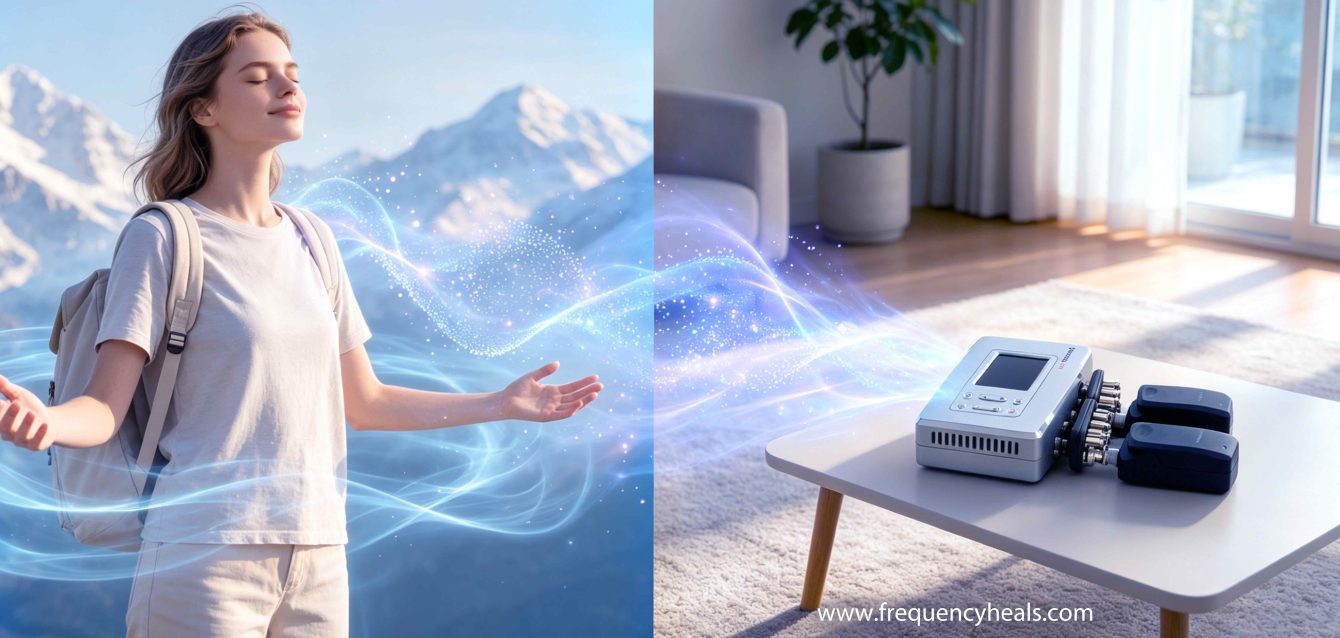
You’re traveling for work and can’t bring equipment. Your elderly parent lives in another city and isn’t comfortable operating a device. Your pet is unwell at home while you’re away. A family member overseas needs support but there’s no one nearby to help. These aren’t edge cases — they’re everyday situations that millions of people face.
Remote Mode was developed to address exactly these scenarios. It allows frequency-based sessions to run continuously — whether the recipient is in the next room or on the other side of the planet — using a DNA sample as the link between the device and the person receiving support. No physical contact. No distance limitation. No need for the recipient to stay near the machine.
Among the various delivery modes available in frequency therapy, each offering a different approach to delivering frequencies — from Direct Contact to Remote Mode — Remote Mode is distinctive in that it is not simply a convenience feature. For many practitioners who work with frequency-based systems, it is their primary delivery method — the one that runs in the background of nearly everything else they do. Understanding why requires understanding both the physics it draws on and the practical mechanics of how it works.
What Is Remote Mode?
Remote Mode is a frequency delivery method in which a small biological sample — typically fingernail clippings, hair, a saliva swab, or a small blood spot on absorbent paper — is placed inside a remote transmission module. The frequency generator then transmits signals into that module. The operating model holds that a connection exists between the DNA in the module and the matching DNA in the person’s living body, allowing frequency information to reach its intended recipient regardless of physical distance [1].
Because the connection is biological rather than spatial, the session continues whether the recipient is asleep, traveling, or going about their day. The module runs silently, requires no active participation from the recipient, and can operate continuously over extended periods — days, weeks, or longer — without interruption.
Each DNA sample is unique to the individual it came from. Sessions are therefore targeted: running a Remote program for one person’s sample does not affect others whose DNA is not in that module. Multiple people or animals can be supported simultaneously by using separate modules, each connected to its own generator channel.
The Scientific Background: Quantum Entanglement and Nonlocality
The theoretical basis cited for Remote Mode draws on one of the most confirmed and counterintuitive principles in modern physics: quantum entanglement.
The concept was famously resisted by Albert Einstein, who referred to it as ‘spooky action at a distance’ — his skeptical term for the apparent ability of two entangled particles to affect each other instantaneously, regardless of the distance separating them. Einstein believed this violated the principle that nothing could influence anything else faster than light. For decades, the debate remained open.
In 2015, a landmark experiment at Delft University of Technology in the Netherlands resolved the question definitively. Researchers led by Ronald Hanson performed a loophole-free Bell test — entangling the electron spins of two nitrogen-vacancy centers in diamonds placed 1.3 kilometers apart and demonstrating correlated behavior that cannot be explained by any local, classical mechanism [2].
The experiment closed the two major loopholes that had allowed previous tests to be questioned, and was published in Nature. Quantum entanglement is no longer a theoretical curiosity — it is an experimentally verified feature of physical reality [2].
Remote Mode in DNA-based frequency therapy invokes this principle as its conceptual foundation: that a DNA sample, once separated from its source, retains a nonlocal connection to the biological system it came from. The generator delivers frequencies into the DNA in the module; the operating model holds that this influences the corresponding DNA in the recipient’s body through this nonlocal link [1].
It is important to be clear about where the science stands. Quantum entanglement as demonstrated in the Delft experiment involves carefully prepared quantum systems under controlled laboratory conditions. The extension of this principle to biological DNA samples at room temperature — and to practical frequency delivery — is the theoretical framework these systems operate within, but has not yet been independently validated through peer-reviewed clinical trials. The underlying physics of nonlocality is real and accepted; the specific application to DNA-based remote frequency transmission remains an active area of exploration, supported by a growing body of practitioner observation and user experience [3].
How Spooky2 Implements Remote Mode
Remote Mode as a delivery method is currently unique to Spooky2 among commercially available Rife-based systems. No other frequency device on the market offers DNA-sample-based nonlocal delivery — it was developed by Spooky2 and remains a defining feature of their ecosystem.
The workflow is straightforward. The practitioner collects a small DNA sample from the recipient — most commonly a fingernail clipping, though hair, saliva, or a dried blood spot also work — and places it inside the Spooky Remote module. The module connects to the frequency generator via the Spooky2 Boost. When a program runs, the generator sends frequencies into the module, which in turn transmits those frequencies to the recipient through the nonlocal DNA connection [1].
The module itself contains two planar coils arranged in magnetic opposition around the DNA sample.
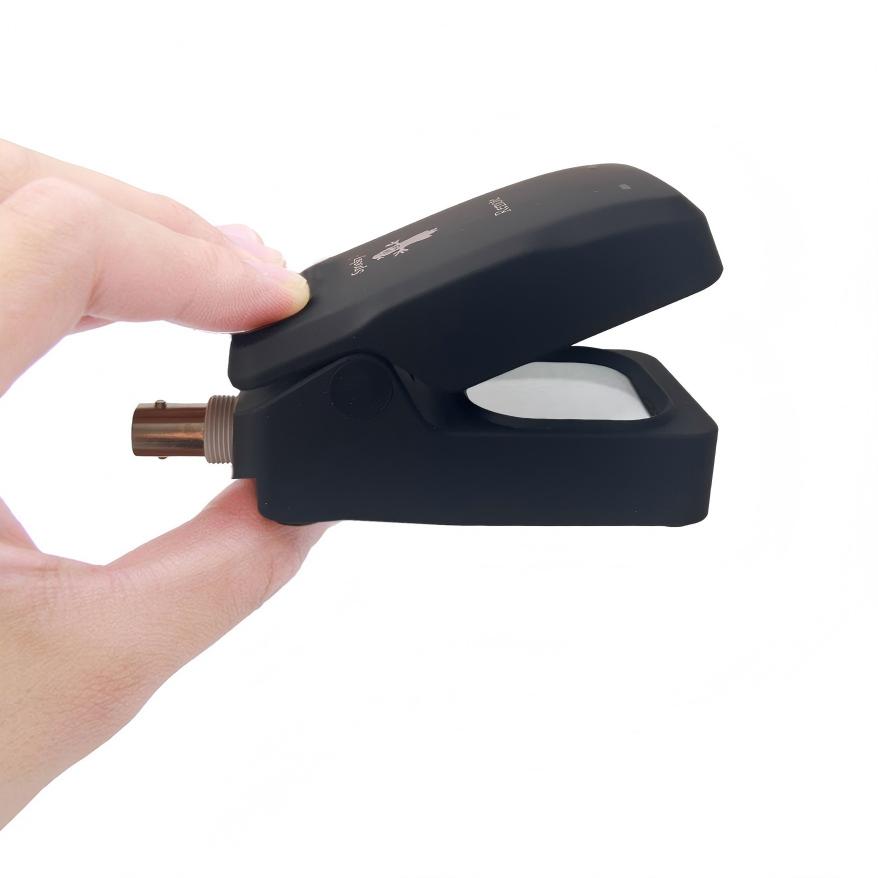
When the generator drives these coils, they create a scalar wave field around the sample — a field that, in Spooky2’s model, strengthens and stabilises the transmission pathway through the DNA. The result is a session that runs completely passively from the recipient’s perspective: no device to wear, no electrodes, no awareness required [1].
Generator compatibility gives practitioners flexibility in how many people or protocols can run simultaneously. The XM Generator supports one Remote module per output channel. The GX Pro supports two output channels simultaneously, allowing two separate Remote modules — and therefore two different recipients or two different protocols — to run in parallel from a single device [4].
One of the most valued aspects of Remote Mode in practice is its compatibility with sleep. Many practitioners run their primary frequency protocols overnight via Remote — the session continues uninterrupted through the night without any effort or awareness from the person receiving support. For long multi-day protocols, such as foundational detox sequences, this continuous operation without breaks is often an important part of the protocol’s design [1].
Who Is Remote Mode For?
Remote Mode’s greatest strength is its passivity — it requires nothing of the recipient during a session. This makes it suitable for a wider range of users than most other delivery methods:
- People with limited mobility or who are bedridden, for whom electrode-based or plasma sessions may be impractical
- Anyone seeking uninterrupted 24-hour support, including during sleep, without wearing or holding any device
- Frequent travelers who cannot bring equipment on the road — the session runs at the home base on their DNA sample while they are elsewhere
- People with high sensitivity who find the electrical sensation of Contact Mode uncomfortable
- Those supporting family members or pets remotely — each person or animal requires their own separate DNA sample in a dedicated module
- Those running long multi-day protocols where continuous operation without interruption is part of the protocol design
- Athletes and active individuals who want background frequency support without interrupting their training or daily routine
Remote Mode is also frequently used as a complement to other delivery methods — running continuously in the background while Contact, PEMF, or Plasma sessions address more acute concerns during dedicated session windows.
DNA Sample Handling: Practical Details
The quality and handling of the DNA sample matters for Remote Mode effectiveness. Fingernails are the most widely used sample — easy to collect, handle, and store without degradation concerns. A small fragment is sufficient. Toenails work equally well. Hair with the follicle attached is also effective, as the follicle contains living cells with intact DNA. Saliva swabs on absorbent paper and dried blood spots are additional options used by practitioners [5].
Samples can be wrapped in paper to receive the scalar field transmission within the module. Labelling each sample with the recipient’s name and collection date is good practice, especially in households running multiple simultaneous sessions. DNA does degrade over time, and most practitioners recommend refreshing samples every few months, or when a shift in session responsiveness is observed [5].
A frequently asked question is whether a session run on one person’s DNA sample affects family members who share some of that DNA. Spooky2’s position is that the connection is specific to the individual DNA in the module rather than to all partial genetic matches, so family members present in the same household are not significantly affected by sessions run for a different person’s sample [1].
Getting Started: Recommended First Protocols
For those new to Remote Mode, the widely recommended entry point in the frequency therapy community is a foundational detox and preparation sequence — sometimes called a Terrain Protocol — designed to prepare the body by systematically supporting detox pathways and clearing opportunistic pathogens before moving into condition-specific frequency work. Such protocols are specifically designed to run via Remote Mode continuously, including overnight, making the most of Remote’s around-the-clock delivery capability [1].
After completing a foundational detox sequence, many practitioners proceed to run a biofeedback scan — available on systems like Spooky2’s GX Pro — which identifies the frequencies the body responds to most strongly at that moment. Those identified frequencies are then run via Remote as an ongoing daily support protocol, tailored to the individual’s current needs rather than relying solely on general presets.
It is worth noting that Remote Mode, by its nature, operates subtly. Unlike Contact Mode where a mild electrical sensation at the electrode points confirms the session is active, Remote Mode offers no direct sensory feedback during a session. Some people notice shifts in energy levels, sleep quality, or symptom patterns within the first few days of use; others notice changes more gradually over weeks of continuous operation. The absence of immediate sensation does not indicate absence of effect — it is simply the nature of a delivery method that works below the threshold of conscious perception.
References
- [1] Spooky2. (2024). How Spooky2 Remote Works.
- [2] Hensen, B., Bernien, H., Dréau, A. E., Reiserer, A., Kalb, N., Blok, M. S., … & Hanson, R. (2015). Loophole-free Bell inequality violation using electron spins separated by 1.3 kilometres. Nature, 526(7575), 682–686.
- [3] Walleczek, J. (Ed.). (2000). Self-Organized Biological Dynamics and Nonlinear Control. Cambridge University Press.
- [4] Spooky2. (2025). Spooky2 Remote Mode Instructions.
- [5] Spooky2. (2025). What Source of DNA for Remote Rife and How Long It Lasts.
- [6] Backster, C. (2003). Primary Perception: Biocommunication with Plants, Living Foods, and Human Cells. White Rose Millennium Press.
- [7] Oschman, J. L. (2000). Energy Medicine: The Scientific Basis. Churchill Livingstone.
- [8] Price, H., & Wharton, K. (2021). Entanglement Swapping and Action at a Distance. arXiv:2101.05370.





Comment
Thank you