


Go to your favorite search engine and type in “coffee memes”. You will get pages upon pages of humorous memes of people struggling to function without their cup (or liter) of brew. And most of us can relate to those memes, because coffee isn’t just something pleasurable to drink, it’s our lifeline to waking up and getting through the day. And that’s the problem.
Our dependency on coffee doesn’t deal with the core issue: getting quality sleep — a process deeply connected to the body’s natural brainwave rhythms and regulatory systems, as explained in how frequency healing works. Experts estimate between 50 million to 70 million adults in the U.S. alone meet the medical criteria for sleep deprivation at any point in time. Masking the problem with a caffeinated quick fix is even dangerous in the long run as chronic sleep disruptions can lead to serious health issues further down the road. What we have learned to accept as “just a way of modern life” is now one of the most critical health issues facing us. Now’s the time to change all that.

Table of Contents
What happened to our sleep?
Our sleep habits are reflective of societal changes that were influenced by technological advances, especially those of the past 150 years. A major cultural transformation in sleep patterns occurred with the widespread availability of artificial light. Before that, few human activities were performed after sunset, so sleep was a normal way to “pass the time”. Electric light made nighttime activities easier and safer, turning sleep into an inconvenient necessity that could be sacrificed in favor of work or social activities.
Industrialization added to the shift from rural-based biphasic sleep (a nocturnal sleep period and a midday nap) to urban-based monophasic sleep (one sleep session at night). The circadian rhythm was disrupted and the sleep window was further shortened with the introduction of shift work, a growing palette of nocturnal activities, and widespread access to television. In more recent years, cortisol-inducing stress tied to longer working hours and the 24-hour news cycle as well as melatonin-inhibiting blue-light exposure from screen use have had a profound impact on the quality of our sleep. Indeed, in an increasingly technological, globalized, nocturnal, and competitive world, sleep has been put on the back burner…and now it’s burning us out.
So how much sleep do we need then?
Perhaps we feel OK after 5 or 6 hours of sleep, but it’s most likely we are kidding ourselves. Recent studies show that at least 30% of American adults are sleeping less than seven hours per night, which is the minimum we should be getting. According to the National Sleep Foundation, here below is number of hours of restorative sleep we should be getting:
- Adults, 65+ years: 7 to 8 hours.
- Adults, 26 to 64 years: 7 to 9 hours.
- Young adults (18 to 25 years): 7 to 9 hours.
- Teenagers (14 to 17 years): 8 to 10 hours.
- School-age children (6 to 13 years): 9 to 11 hours.
- Preschool children (3 to 5 years): 10 to 13 hours.
- Toddlers (1 to 2 years): 11 to 14 hours.
- Infants (4 to 11 months): 12 to 15 hours.
- Newborns (0 to 3 months): 14 to 17 hours.
To dream or not to dream: a breakdown of our sleep cycle
Sleep isn’t uniform: over the course of the night, we go through four to six sleep cycles, each of which is composed of four stages based on rapid eye movement and brain activity. The first three stages are Non-REM, and the final stage is REM. The first sleep cycle is often the shortest, ranging from 70 to 100 minutes, while later cycles tend to fall between 90 and 120 minutes.
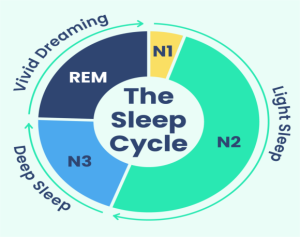
These are the four phases of sleep:
Stage 1 NREM sleep
It is the transition from wakefulness to sleep. This brief transition typically lasts only a few minutes. The brain waves during this stage transition from daytime patterns to nighttime patterns.
Stage 2 NREM sleep
This is when most people would consider themselves to be “asleep”. Heart rate and breathing continue to slow down, and the muscles continue to relax. During this stage, which lasts between 30 and 60 minutes, body temperature decreases, the eyes stop moving, and the brain begins to have slow-wave activity.
Stage 3 NREM sleep
Which lasts approximately 20 to 40 minutes, is known as deep sleep or slow-wave sleep. It is the part of the sleep cycle that allows us to feel refreshed in the morning. During this stage of sleep, blood pressure will have decreased, muscles will have relaxed, and breathing and heart rate will have slowed down to allow for tissue regeneration and beneficial hormone secretion. Recent studies now show that it’s during this stage that the glymphatic system is most active, removing neurotoxic proteins from the brain, which is key in preventing neurodegeneration.
REM sleep
This is the part of the sleep cycle when the body processes and consolidates received information, moving it from temporary to permanent memory. REM sleep starts about 90 minutes into sleep. During this stage, the body activity changes dramatically from the other stages of sleep. Eye movement and brain activity increase, heart rate and blood pressure rise to awake levels, and breathing becomes faster and irregular.
The NREM deep sleep stages are restorative, allowing the body to detox and repair, while the REM stage allows information “collected” in our waking hours to be sorted though and stored away. All stages are necessary for our well being. Sleep cycles can vary from person to person and from night to night based on a wide range of factors such as age, recent sleep patterns, and alcohol consumption. It is logical to conclude that any negative influence on the sleep cycle can impact our health. Sleepers who frequently wake up during earlier stages, such as those suffering from apnea, may struggle to properly cycle into these deeper phases of sleep. On the other hand, people with insomnia may not get enough total accumulated sleep needed at each stage. Let’s now look into what disrupts these sleep patterns.
Sleep disorders: when our sleep cycles are disrupted
The collective term sleep disorder refers to conditions that affect sleep quality, timing, or duration and impact a person’s ability to properly function while they are awake. These disorders can contribute to other medical problems, and some may also be symptoms for underlying mental health issues. There are more than 100 specific sleep disorders, and most of them can be characterized by one or more of the following signs:
- Having trouble falling or remaining asleep
- Finding it difficult to stay awake during the day
- Circadian rhythm imbalances that interfere with a healthy sleep schedule
- Unusual behaviors that disrupt sleep
The first symptoms of sleep disorders… and what could happen when you ignore them
It’s certain that after a night of inadequate sleep, most of us have experienced these symptoms: sluggishness, frequent yawning, lack of concentration, dark circles under the eyes, and irritability. However, when these symptoms linger on for several days on end, extending into months, then we are dealing with chronic sleep deprivation, which accumulates into what is known as sleep debt. Herein lies the danger of accepting sleeplessness as a way of life. The bigger the sleep debt, the more susceptible we are to more serious afflictions, which include:
- Hypertension
- Heart attacks
- Impaired thyroid function
- Strokes
- Obesity
- Diabetes
- Depression
- Anxiety
- Decreased brain function
- Memory loss
- Weakened immune system
- Lower fertility rates
- Psychiatric disorders
- Alzheimer’s disease
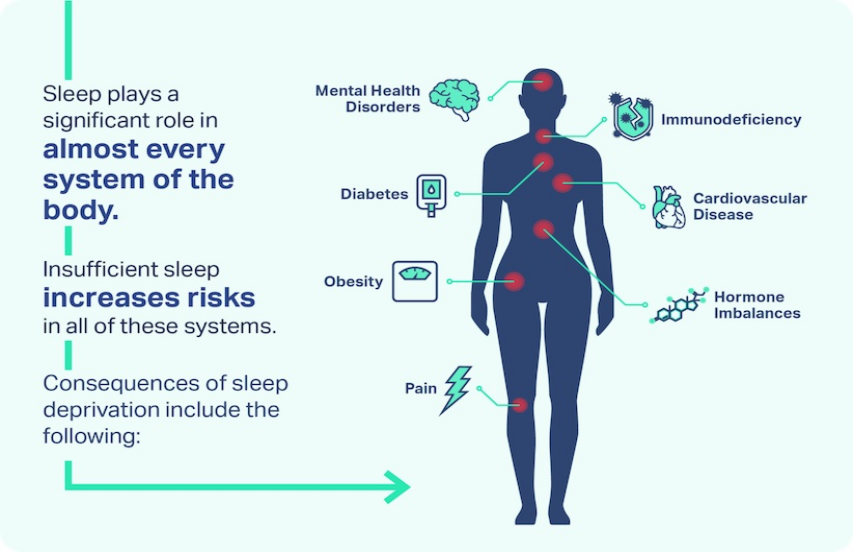
When we consistently get less than the recommended amount of sleep, our body’s ability to detox, repair and regenerate cells is impaired. Research has shown that sleep deprivation leads to increased inflammation, accelerated cellular aging and a greater risk of disease, which significantly impacts life expectancy.
The different types of sleep disorders
Most sleep disorders fall into two categories: sleep deprivation and insomnia, and both concern the sleep that people aren’t getting to be healthy and alert. In both cases, sleep is often fragmented and the sleep cycle is disrupted throughout the night, inhibiting restorative, deep sleep.
People dealing with sleep deprivation can easily fall asleep and stay asleep, but external factors tied to their schedules and lifestyle choices impede getting the quality sleep they need. Alas, sleep deprivation is often only diagnosed after it’s become severe and chronic.
With insomnia, people have ample opportunity to sleep, but they struggle with falling asleep, staying asleep, or both. Up to two-thirds of adults periodically experience some form of insomnia, which occurs more frequently with age and is often exacerbated by anxiety and depression.
Sleep deprivation and insomnia occur when there are one or more problems with your sleep environment, your physical well-being or your emotional/mental well-being. The good news is that you have the means to remedy most of these issues on your own.
A new addition to your sleep sanctuary: Solfeggio Frequencies, Binaural Beats and Rife Frequencies
As you embark on the journey to sound asleep, consider using sleep-inducing frequencies. Imagine a bedtime ritual where the gentle hum of frequencies lulls you into a blissful state of calm. You will see that with little effort, you can incorporate these frequencies into your sleep sanctuary.
Every sound wave carries energy that can interact with our brainwaves, cells and even our emotions. When it comes to sleep, certain frequencies can help calm the mind, reduce stress, and guide us naturally out of insomnia and into deeper states of rest. Frequencies that target specific health issues can alleviate what impedes restorative sleep, getting the body back into a virtuous circle of health.
Other ways in which frequencies benefit sleep is through increased melatonin production, reduced cortisol levels and a rewiring of the neural pathways that match a healthy sleep cycle. Much of this is done through something known as brainwave entrainment. For example, when we listen to low-frequency sounds, our brainwaves synchronize with slower rhythms to mimic those during deep, restorative sleep.
Solfeggio frequencies, which are a set of ancient musical tones, is a powerful sleep-enhancing tool that focuses on emotional relaxation, especially when played at 417 Hz, 432 Hz or 528 Hz, the three frequencies known to have a deep calming effect. Even the 174 Hz frequency, which associated with reducing physical pain and easing tension, can help us unwind for deeper, more comfortable sleep.
Recent studies have shown that sleep can also be supported by listening to Binaural Beats, in which two different tones are delivered via headphones to create a third phantom tone which helps the brain ease into the third NREM stage for restorative deep sleep (Delta waves- 0.5 Hz to 4 Hz). On the other hand, Binaural Beats can also be played at 4 Hz to 8 Hz (Theta waves), which helps bridge the gap between wakefulness and deep sleep, making it easier to fall asleep and enter a dream-rich, emotionally nourishing stage of rest. It’s best to start listening to binaural beats 20-30 minutes before bedtime to gently segue into a deep sleep.
Rife Frequencies is the final frequency-based therapy that precisely targets and neutralizes irregularities within the body that affect sleep quality and duration. You can customize different Rife frequencies to make a personal sleep “playlist” to deal with several issues that could be affecting your sleep. As these frequencies are resonant and not perceptual, they can be played without the volume on, which means they can accompany you throughout the night.
The charts below cover the most common sleep challenges. Just click on the link to the frequency that corresponds best to what’s keeping you from a sound sleep to start your journey to dream land:
Alleviating physical issues that disrupt sleep
Rife Frequencies
Solfeggio Frequencies
Alleviating physical issues that disrupt sleep
Rife Frequencies
Solfeggio frequency
Binaural Beats
With this tool, you can create your own Theta (4–8 Hz) and Delta (0.5–4 Hz) binaural beats. Theta waves are commonly associated with deep relaxation and can be helpful for those who have trouble falling asleep. Delta waves are linked to deep, restorative sleep and may help reduce night awakenings. Click the link below to begin.
Binaural Beats Generator
Design your own binaural beats audio to aid in focus, relaxation, or meditation.
Tips for using frequencies
- Listen to your body’s response: Try different frequencies and notice how you feel. The best frequency for you is the one that helps you relax and feel calm.
- Test different formats: Try pure tones, ambient music infused with frequencies and binaural beats.
- Be consistent: Stick with one frequency for at least 3–5 nights to give your body time to adjust. However, don’t stop there: keep using frequencies for several weeks and keep a log noting the frequencies used and any improvements you have in your sleep.
- Start listening before bedtime: Begin playing the frequencies about 15 to 30 minutes before you plan to sleep. This gives your brain and nervous system time to gradually slow down and prepare for rest. Think of it like warming up before exercise: easing into sleep makes a big difference.
- Keep the volume soft and comfortable: Play the frequencies at a low, comfortable volume that allows your body to relax without overstimulating your senses.
- Combine with deep breathing: As you listen, practice slow, deep breathing. Inhale for four seconds, exhale for six seconds. Deep breathing enhances relaxation, lowers your heart rate, and helps the body fully settle into the sleep mode.
Try It Yourself: Generate Your Frequencies for Free
Now that you have the hang of using frequencies to improve your sleep, why not generate a few of your own for an even more personalized experience?
Online Tone Generator
Generate a precise mixed audio by combining up to 7 different custom frequencies.
There’s so much that you can do to improve the quality of your sleep, that it may be overwhelming. Incorporate new sleep habits progressively and keep a sleep journal to note what modalities work best for you. Now that you have a hand in reclaiming your sleep, you can finally put that cup of coffee down. Sweet dreams!








Comments
I had this 30 years ago and lost it. Thanks for putting it up again. So that I can enjoy .
Have it helped me in this part of my life.
Please do not lose me !!!!
Hi Cathy,
No worries. We won’t lose you! 😊 You’re already part of our community, and we’re happy to have you with us.
If you’d like to explore more frequency content and stay connected with our latest updates, you’re welcome to subscribe.
Thank you for your support and for exploring Frequency Heals with us. We truly appreciate having you here. 💙✨
Hi , I’m new to all this and looking forward to using it. I have two questions:
1: I wear hearing aids and have to be out on a charger at night . Can i still benefit the frequency’s to help me sleep ?
2: is there a frequency to help with bad habits ( like smoking)?
Hi Debbie 💜
Welcome to the Frequency Heals community! 😊 We’re happy to have you here.
Regarding your questions:
🎧 1. About hearing aids and sleep sessions
Yes, you can still explore frequency sessions even if your hearing aids need to be removed for charging at night. You can listen at a time that works best for you, such as before sleep or during a quiet relaxation period.
If you prefer, you can also explore sessions without hearing aids, as everyone’s listening experience can be different.
🌿 2. About habits such as smoking
We have some content related to addiction and habit support that you may explore here:
https://www.youtube.com/@FrequencyHeals/search?query=addiction
We recommend listening at a comfortable volume and creating a routine that feels right for you. 💙
Thank you for joining our community, and we hope you enjoy exploring your frequency journey. ✨