Here’s the good news: meditation is no longer an esoteric practice reserved for gurus. There’s no need to go on a trip to India and fast for 40 days, nor to sit cross-legged with your hands doing the mudra just right. Meditation can be done in any position or even while walking. It can be done when you first wake up in the morning or during your lunch break. In fact, there is no “perfect” way to meditate; you just need to find out how to best enter that space.
No matter how you choose to meditate, you can boost your experience with an age-old modality that has received a modern upgrade: sound frequencies.

Many people already use some form of audio support to enhance their meditation sessions. Some of them, like didgeridoos and Tibetan bowls, go back to ancient times, while others, like guided recordings and Spotify playlists, cater to more modern practitioners. Audio accompaniment gives sensorial support to those who are uncomfortable with silence and allows more experienced meditators to “feel” the sounds that blend into their introspections. Among the many frequency-based approaches used in meditation, Solfeggio frequencies are one of the most well-known examples, with unique tones traditionally associated with different meditation practices.
That “feeling” is actually based in science. Sound frequencies have undergone a renaissance as a powerful ally in meditation. The bowls are still there, but now more and more people are discovering the ease and accessibility of powerful sound frequencies and binaural beats, which are also explored as a tool for relaxation and calming practices.
The connection between frequencies and meditation
Meditation trains the brain
Meditation is more than a simple mental exercise: it alters the brain’s electric activity, the neural oscillations known as brainwaves. A given mental state has a direct influence on the frequency and amplitude of these brainwaves. The brain operates using five primary types of electrical activity that correspond to different states of consciousness and are defined by frequency (Hertz, or Hz):
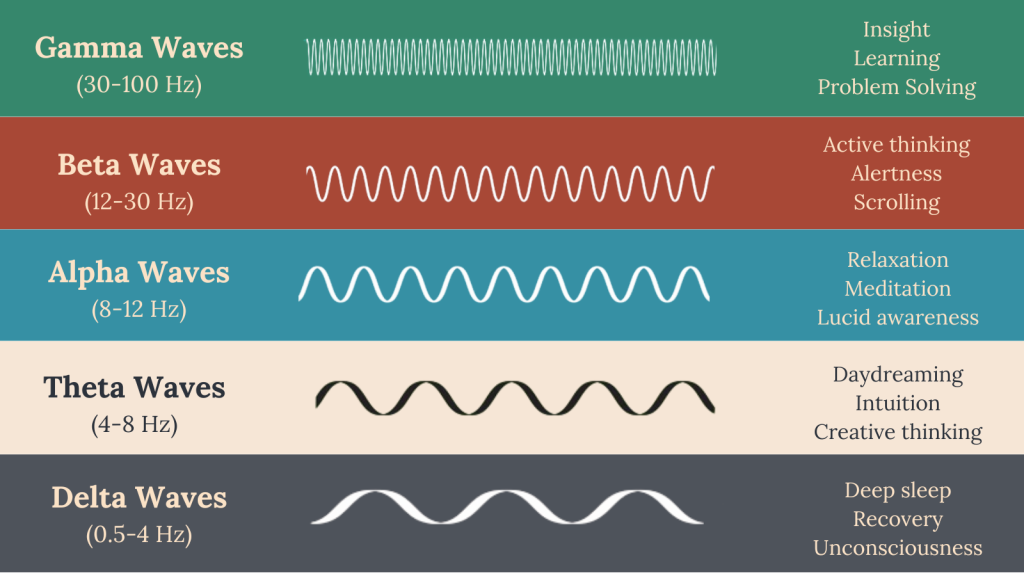
Higher frequency waves relate to alertness and cognitive function, while slower waves correlate with deep relaxation and restorative states. Novices will find themselves leaving their more active gamma and beta states and entering alpha relaxation. More experienced practitioners can reach theta-level meditative immersion, which leads to deeper insights and increased creativity. Those who have mastered advanced meditation over long periods of time can access high-frequency gamma waves associated with intense focus, rapid information processing, and sudden insight.
But that’s not all: when we meditate, our brains start to reconfigure its neural pathways in a process known as neuroplasticity. Meditation both increases the focus and decision making processes of the prefrontal cortex and decreases the stress and fear responses of the amygdala.
Frequencies train the brain, too
There are two ways to engage the brain and body with frequencies: binaural beats and solfeggio tones. Listening to binaural beats involves wearing headphones to receive two different frequencies in each ear. The difference in frequencies of the two tones will produce a third phantom tone in a process called brainwave entrainment. This is how brainwaves become synchronized with external frequencies. Modeling brainwave states is a powerful means to enriching your meditation sessions to help you reach your wellness and upliftment goals.
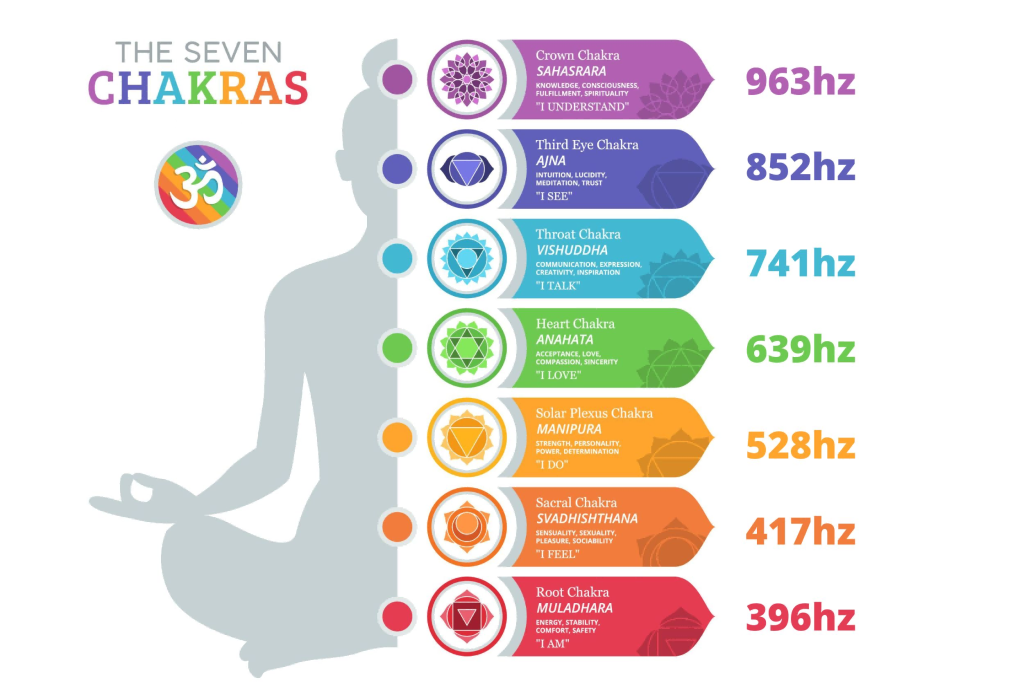
Solfeggio tones, which comprise a scale of 9 frequencies, offer a more classically immersive experience. Usually delivered via speakers, these frequencies harness a vibrational resonance that influences your body’s biofield to produce different outcomes. As ambient frequencies, solfeggio tones can provide the conditions favorable for relaxation, spiritual upliftment and healing. Here is a pretty basic description of the benefits of each frequency (note that there are other frequencies that exist outside the solfeggio scale):
- 174 Hz: Physical healing and Pain Relief
- 285 Hz: Cellular healing/tissue regeneration
- 396 Hz (root chakra): Liberating guilt and fear
- 417 Hz (sacral chakra): Undoing situations/trauma and facilitating change
- 528 Hz (solar plexus chakra): Transformation and miracles/ DNA repair
- 639 Hz (heart chakra): Connections/relationships
- 741 Hz (throat chakra): Detoxing and expression/finding solutions
- 852 Hz (third eye chakra): Awakening intuition
- 963 Hz (crown chakra): Higher consciousness/spiritual upliftment
Frequencies engage the brain (and more!) during meditation
Sound frequencies aid in meditation by giving you give a point of attention to settle around. Low, steady sounds can help in relaxation and awareness, while higher, harmonically layered tones are more stimulating and can provide clarity.
These frequencies affect more than just the brain. As the human body is made mostly of water, sound vibrations travel through it, interacting with the nervous system and body tissues. This gentle internal movement, known as resonance, can help release physical tension and activate the parasympathetic nervous system.
Using the broad generalization that binaural beats are more brain-focused and solfeggio tones are more all-encompassing, we can incorporate them accordingly into a powerful mediation session. Look at the offering of brainwaves and frequencies as a sort of buffet from which you can compose your meditative menu.
Incorporating frequencies into your meditation session
Meditation works best when it is done consistently and meaningfully. Adding frequencies to meditation will enhance that experience. Here are some suggestions to help you integrate frequency-based meditation into your daily life:
1. Pick a time and place to meditate.
Many people find morning meditation sets a positive tone for the entire day, while others prefer evening sessions to process and integrate their daily experiences. Calm, comfort and accessibility should be the key criteria in choosing a location to meditate. Even your bed is a good place!
2. Set your intention.
People meditate for a number of reasons, whether it’s for emotional support, physical relief, personal development or spiritual upliftment. As we start exploring frequencies, defining your desired outcome will guide you to the right binaural beats and/or solfeggio frequencies to incorporate into your meditation session.
3. Select your frequencies.
You have set your intention; now it’s time to apply frequencies to them. Let’s look at the previously mentioned intentions one by one:
Meditation for emotional growth and support: Begin by directing loving thoughts toward yourself, then extend them to loved ones, neutral people, difficult people, and finally all beings. This cultivates compassion and emotional resilience. As you move on, you can tackle more difficult issues, because you’re more accepting of yourself. Consciously explore the aspects of yourself that you typically avoid or deny- your fears, insecurities, and negative patterns- with the aim of transforming them into sources of strength and wisdom.
The frequencies you can incorporate into the session: 396 Hz (liberating guilt and fear), 417 Hz (undoing negative situations/trauma/emotional blockages), 432 Hz (creating peace within, reducing stress), 528 Hz (reducing anxiety), 639 Hz (forgiveness, empathy, trust, and emotional connection), 741 Hz (emotional detox), 963 Hz (quieting the ego). The best binaural beat frequencies: 10 Hz (alpha), 6 Hz (theta), and 40 Hz (gamma) for reducing anxiety and promoting calm.
Important: Meditation sometimes brings up challenging emotions or memories. You might notice negative patterns or emotions that were previously tucked away in your subconscious. This temporary discomfort is often a sign that healing and growth are occurring. If emotions become overwhelming, consider working with a qualified meditation teacher or therapist.
Meditation for physical well-being: Lie down and scan over the different parts of your body, from your toes to the top of your head. Acknowledge these sensations without judgment and consciously release each part into relaxation. This practice will help you develop a stronger mind-body connection that supports holistic well being.
The frequencies you can incorporate into the session: 174 Hz (pain relief, physical recovery), 285 Hz (cellular healing and tissue regeneration), 432 Hz (slowing down the heart rate), 528 Hz (repairing DNA, promoting healing and vitality), 741 Hz (detox), 639 Hz and 963 Hz (supporting deep, restorative sleep). The best binaural beat frequency: 0.1-4 Hz (delta) for deep, restorative sleep and pain relief.
Meditation for personal development: Visualization is a powerful technique that helps align your subconscious mind with your conscious intentions, making personal transformation more likely to occur. We can say this is next-level daydreaming. You are allowed to personalize this vision to the most minute detail. The key here is to imagine that this vision is happening now, then observe your (positive) emotions in reaction to living that vision. Be careful to visualize just what you want, and not what you don’t want. The frequencies mentioned here are for cultivating supportive soft-skills:
The frequencies you can incorporate into the session: 417 Hz (facilitating change and adaptability), 528 Hz (creativity and problem-solving skills), 639 Hz (harmonizing relationships and enhancing communication), 741 Hz (mental clarity, focus and self expression). The best binaural beat frequencies: 4–8 Hz (theta) for enhanced creativity, 8-12 Hz (alpha) for better retention of information, 13-30 Hz (beta) for improved cognitive performance, focus and productivity, 30-100 Hz (gamma) for greater recall.
Meditations for spiritual upliftment: As your meditation practice matures, you can explore more sophisticated techniques that offer opportunities for profound transformation. Working with the seven energy centers (chakras) in your body will not only help you create a spiritual connection, it will also guide you in identifying and working on specific areas of personal development. Common chakras targeted for personal development are the sacral chakra for greater confidence, the solar plexus chakra for more drive, and the throat chakra for improved communication.
The frequencies you can incorporate into the session: 423 Hz (natural harmony and grounding), 741 Hz (intuition and insight-based meditation), 852 Hz (higher self, spiritual awareness and inner guidance), 963 Hz (divine consciousness and universal unity). The best binaural beat frequencies: 0.1-4 Hz (beta) for inner harmony and connection, 4–8 Hz (theta) for deep meditation.
How to combine solfeggio tones and binaural beats:
This is a little technical, so the rule of thumb is to start simple and layer as you go. As most of us are neither sound engineers nor physicists, the best way is to start with tailored recordings on YouTube, then explore solfeggio presets and binaural beats separately, and then start to combine them in one of two ways:
For purposes of clarity, let’s say we want to work on pain relief. We would select the solfeggio frequency of 174 Hz, with a 2 Hz (delta brainwave) binaural beat. There are two ways to set this up:
Symmetrical Bracketing Configuration (e.g., 173 Hz left channel, 175 Hz right channel)
The carrier frequency would be 174 Hz- the solfeggio target frequency. This calculates the inputs to maintain the exact target frequency as the central carrier while generating the desired delta entrainment. The brain integrates the signal as a 2 Hz beat riding directly on a 174 Hz carrier. This is mathematically efficient for single-layer applications where minimizing audio tracks is necessary.
Layered Configuration (e.g., 174 Hz continuous tone + Independent Binaural Pair)
Layer 1: 174 Hz mapped symmetrically to both channels as a pure sine wave.
Layer 2: Binaural pair at distant, unrelated frequencies (e.g., 400 Hz left channel, 402 Hz right channel). The auditory system receives an unmodulated, continuous 174 Hz frequency with an independent binaural pair simultaneously inducing the 2 Hz entrainment at the brainstem level.
Important! The sound palette of frequencies and binaural beats range from silent to buzzy. Sometimes they are integrated into meditation music, sometimes they are heard on their own. It make take some time to get used to them. It’s best to start with the volume all the way down and turn it up to a comfortable level.
You may also note that there is a certain amount of overlap with the frequencies, with a given frequency serving several purposes. This is normal. It is entirely up to you to experiment with frequencies and binaural beats and see how they work for you.
4. Now you can prepare your body and mind for meditation.
You can be in the most “zen” of meditation spaces, but your mind can still be racing and your body might be tense. The act of preparing both body and mind is a ritual in itself, signaling the shift from the external to the internal. Doing 5 minutes of heart coherence breathwork is an easy way to enter into a calm state.

Some tips to help you on your meditation journey
1. Be easy on yourself
It may take some time to get “into the zone”, and you may find your thoughts wandering. That’s okay- just acknowledge this without judgment and carry on. Use sound as an anchor, letting the tone be your point of focus. Note the rise and fall of the vibration and welcome the sound into your inner world.
While being consistent with your daily meditation practice is ideal, it’s okay if you decide to take a walk in the park instead of a 20-minute sit-down session. It’s all good!
2. Ease into it
If you’re a newcomer to meditation, 5 or 10 minutes may be all you can handle. Slowly build up your sessions to at least 15-20 minutes a day. Consistency is key.
3. Keep track of your progress
It may take some time to get used to some of the more mechanical sounds of certain frequencies and binaural beats. Keeping a meditation journal will help you keep track of what works best for you. Note the frequencies you’ve used and how they affect your mood, energy and overall well-being.
More and more people are realizing that meditation is an accessible and extremely powerful tool in manifesting personal goals, achieving better emotional and physical health, and elevating ourselves spiritually. Now there is also a wide array of frequency tools to accompany you on this journey.
FAQ
How long does it take to see the benefits of meditation?
It depends on the desired outcome. You can achieve relaxation within minutes; however much of the deeper work will require at least a few weeks of daily practice. Structural changes in the brain typically happen after 6–8 weeks of consistent meditation.
Does “the longer, the better” apply to meditation? It is not impossible to achieve benefits with just 5-10 minutes a day…if you’re doing it daily. It’s better to do a little bit every day than an hour session once in a blue moon. Ideally, put aside 15-20 minutes per day, but don’t beat yourself up if you miss a day.
I’m having trouble listening to frequencies- can I play them while listening to other music?
It’s generally best to listen to frequency tracks on their own so the rhythmic patterns remain clear. However, you can acclimate to them by pairing them to compatible music tracks and gradually weaning yourself off the music as you become more comfortable.
Should I play these frequencies at a certain volume?
Frequencies do not need to be played loudly to be effective. A comfortable listening level is usually best. If the sound feels too strong or distracting, simply lower the volume. The goal is gentle exposure rather than intensity.
What is the better means of delivering frequencies: from my computer or from my smartphone? Do I need to use headphones?
Both computers and smartphones work well for playing audio frequencies. Headphones can be helpful for immersive listening or when using binaural tones, but they are not always required. Many people also benefit from playing frequencies softly in the background during daily activities.
Resources:
- Mindfulness meditation alters neural oscillations independently of arousal – ScienceDirect
- How Meditation Changes Your Brain Waves – ScienceInsights
- What Is Neural Entrainment & How Does It Work? – Biology Insights
- Neuroplasticity through sound: how specific frequencies can rewire the brain – Ziba Guru
- Difference Between Binaural Beats and Solfeggio Frequencies
- Best Frequencies for Meditation: Simple Ways to Enhance Your Practice
- 25 Meditation Benefits for Brain Health Backed by Science