

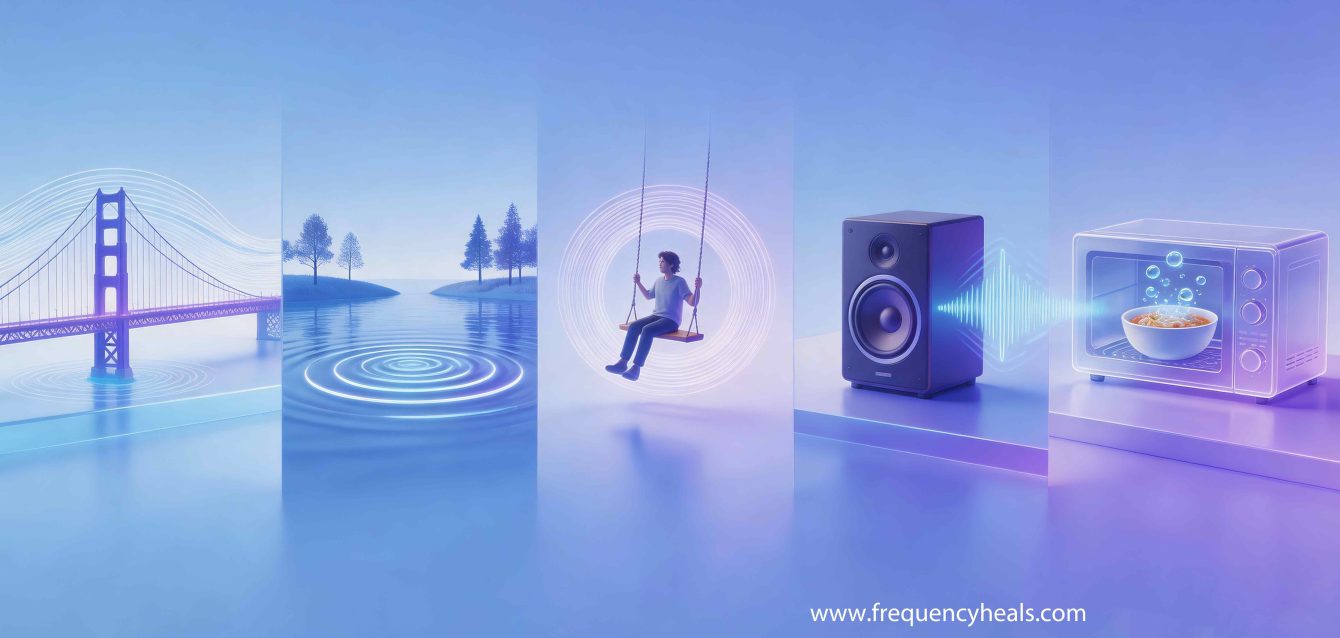
There’s a particular satisfaction in learning a concept and then suddenly seeing it everywhere you look. That’s what tends to happen with resonance.
Once you understand the basic idea — that systems with natural frequencies respond most strongly when they’re nudged at exactly those frequencies — you start noticing it in the world with a kind of quiet delight. In the hum of a wine glass rim traced with a wet finger. In the way a long suspension bridge sways in the wind. In the deep, almost physical pleasure of a chord that rings true.
In this article, we’re going to walk through examples from the physical world, from living nature, and from ordinary daily experience. The goal isn’t to catalog every instance of resonance in existence. It’s to make the concept feel lived-in and familiar. Because once it does, the conversation about resonance in the human body — and in frequency-based health practices — becomes much easier to have.
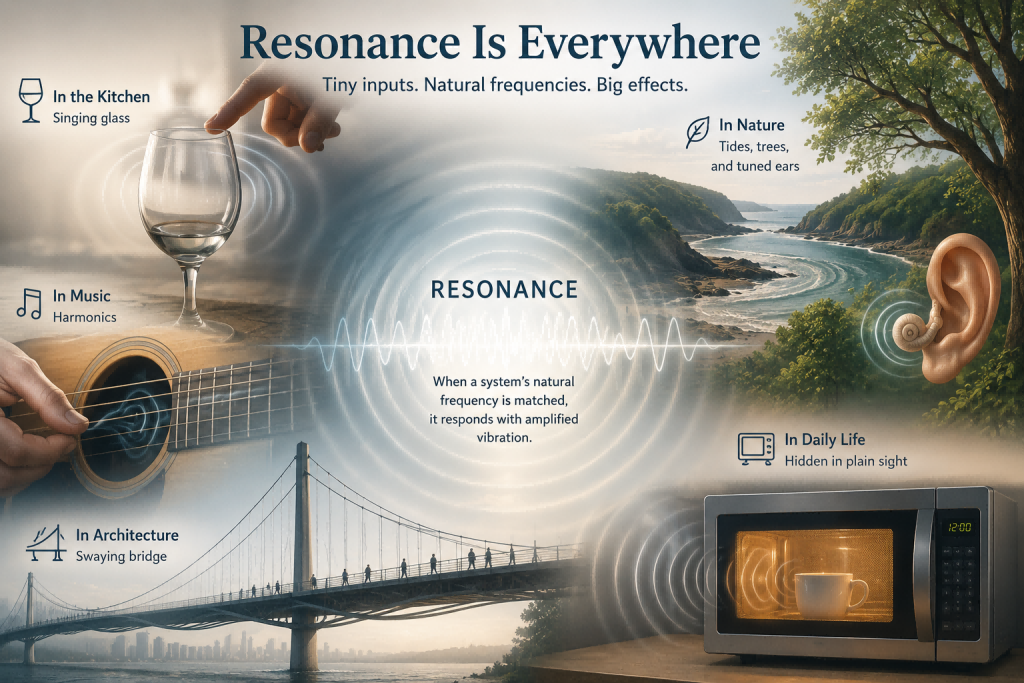
In the Kitchen: The Singing Glass
Let’s start somewhere most people have encountered, even if they didn’t have the physics language for it at the time.
Run a moistened finger slowly around the rim of a wine glass and it begins to sing — a clear, sustained tone that seems almost too pure to be coming from a piece of tableware. What’s happening is this: the friction between your finger and the glass rim sets the glass into vibration at its natural resonant frequency. The glass amplifies that vibration, and the surrounding air carries it to your ears as sound [1].
The pitch of the tone changes with the size and thickness of the glass, and with how much liquid is in it. Add water and the effective mass of the vibrating system increases — which lowers the natural frequency and drops the pitch. Wine glass musicians — yes, this is a real performance tradition — tune their glasses precisely by adjusting water levels, then play melodies by running dampened fingers across multiple glasses in sequence [1].
It’s a lovely, low-stakes example. But it contains the full physics: a system with a natural frequency, excited by an input that matches that frequency, responding with amplified and sustained vibration.
In Music: Why Instruments Sound the Way They Do
Music is essentially applied resonance. Every acoustic instrument works by creating and shaping resonant vibrations — and the particular combination of resonant frequencies an instrument produces is what gives it its distinctive voice.
A guitar string, when plucked, doesn’t just vibrate at a single frequency. It vibrates at its fundamental frequency and simultaneously at a series of higher frequencies called harmonics or overtones — at twice the fundamental, three times, four times, and so on [1]. Each harmonic has a different amplitude depending on how and where the string is plucked. The body of the guitar then resonates selectively with some of those frequencies more than others, amplifying certain harmonics and shaping the overall sound.
This is why a note played on a nylon-string classical guitar sounds so different from the same note on a steel-string acoustic, even at the same pitch. The strings are different, the body materials are different, and therefore the resonant profile is different. The fundamental frequency — the pitch — is the same. The harmonic content and the resonant shaping are not.
The human voice works the same way. Your vocal cords vibrate at a fundamental frequency determined by their tension and mass. But the resonant cavities of your throat, mouth, and nasal passages selectively amplify different harmonics depending on the shape you make with those spaces. This is how vowel sounds are formed — and it’s why a trained singer can project sound across a full concert hall without amplification. They’ve learned to shape their resonant cavities in ways that direct acoustic energy into the frequencies that carry best [2].
In Architecture: Buildings That Move
Buildings, it turns out, have natural frequencies too — and engineers spend considerable effort making sure those frequencies don’t get excited by the wrong things.
Every structure has characteristic ways it prefers to sway or oscillate when disturbed. Tall, slender buildings tend to have lower natural frequencies — they sway slowly. Short, stiff structures have higher natural frequencies. The concern is that earthquakes, high winds, or even rhythmic human movement can produce forces at frequencies that match the building’s natural frequency — and if that happens, energy accumulates and the motion amplifies [3].
A famous cautionary example: London’s Millennium Bridge opened in 2000 and had to be closed two days later. When crowds of pedestrians walked across it, their naturally synchronized footsteps created a rhythmic lateral force that happened to match the bridge’s natural swaying frequency. The bridge began to sway visibly, which caused pedestrians to unconsciously adjust their gait to match the motion — which reinforced the swaying further. Engineers installed dampers to absorb the resonant energy, and the bridge reopened safely [3].
What’s fascinating about this example is the human element: the pedestrians weren’t trying to destabilize the bridge. They were just walking. But their natural tendency to synchronize their steps to the movement they felt beneath them created a feedback loop that amplified the resonance. We’ll revisit this idea in the next article — it’s one of the most interesting things about resonance in living systems.
In the Natural World: Tides, Trees, and Tuned Ears
Nature is extraordinarily good at resonance — partly because evolution tends to select for systems whose frequencies are well-matched to the environments and signals they need to respond to.
Ocean tides and coastal geography. The Bay of Fundy in Canada experiences the world’s highest tides — water rising and falling by up to sixteen meters — because the natural resonant period of water sloshing back and forth in the bay closely matches the roughly twelve-hour period of lunar tidal forcing. The geometry of the water body determines its natural frequency; the match or mismatch with tidal periods determines the amplitude of the tide [4].
Trees in the wind. Trees are not rigid. They flex, sway, and oscillate — and each species, depending on its height, mass distribution, and wood stiffness, has a characteristic swaying frequency. Research in biomechanics has shown that tree architecture often appears to be tuned to avoid resonance with the most common wind frequencies in their environment — an adaptation that reduces structural damage risk during sustained winds [4]. And here’s something counterintuitive: young trees that are staked too rigidly actually fail to develop proper trunk strength, partly because the mechanical stresses of swaying motion trigger wood-strengthening responses at the cellular level. The tree needs to resonate a little to grow well.
The cochlea — a resonance detector built into your skull. Your inner ear contains one of the most elegant resonance-based sensors in nature. The basilar membrane inside the cochlea is tapered — narrow and stiff near the base, wide and flexible near the apex. High-frequency sounds cause maximum vibration near the stiff base; low-frequency sounds travel further and cause maximum vibration near the flexible apex. Different hair cells along the membrane are therefore tuned to different frequencies, each responding most strongly to its preferred resonant frequency [2]. Your perception of pitch is, at its most fundamental level, a map of resonant positions along a spiral membrane.
In Daily Life: More Resonance Than You'd Expect
Outside the concert hall and the physics classroom, resonance shows up in surprisingly ordinary places.
Microwave ovens. Microwave ovens heat food by emitting electromagnetic radiation at a frequency — around 2.45 gigahertz — that is efficiently absorbed by water molecules. The water molecules in food rotate and vibrate in response to this frequency, generating heat from the inside out. It’s resonant absorption at the molecular scale, made domestic and mundane [5].
Radio tuning. When you tune a radio to a station, you’re adjusting an electrical circuit’s resonant frequency to match the frequency of the broadcast signal. The circuit resonates with that frequency and ignores others. Every radio, at its core, is a resonance filter [5].
The satisfying thud of a well-closed car door. Car manufacturers spend real engineering effort on this. A door that closes with a solid, low thud communicates quality and safety — and that sound is partly engineered through the resonant properties of the door’s materials and cavity. The frequency and decay time of that sound are shaped deliberately. You’re hearing resonance, and interpreting it as craftsmanship [1].
Glasses rattling on a shelf when a truck passes outside. The vibrations traveling through the ground from a heavy vehicle contain a range of frequencies. If one of those frequencies happens to match the natural resonant frequency of a glass on your shelf, that particular glass will rattle while others nearby sit still. Frequency selectivity, right in your kitchen.
The Body in This Picture
We’ll go much deeper into bodily resonance as this series continues, but it’s worth pausing here to note how many of the examples above have direct counterparts in human physiology.
The cochlea’s resonance-based frequency analysis is mirrored, in a different form, by the way neurons process rhythmic input — with different neural circuits responding preferentially to different temporal patterns [2]. The heart and breath fall into resonant synchrony at specific breathing rates. Bones and soft tissues have mechanical resonant frequencies that can be engaged therapeutically. Cells respond to oscillating mechanical and electromagnetic fields through frequency-selective membrane proteins [5].
The body is not one resonating system. It’s a nested collection of them — molecular, cellular, organ-level, and whole-system — each with its own preferred frequencies, each capable of responding disproportionately to inputs that match those frequencies.
What the examples in this article establish is that this kind of frequency selectivity is not exotic or unusual. It is completely ordinary. It’s in your kitchen, your car, your radio, your ear. Resonance is simply what happens when you match a system’s natural frequency — and nature, technology, and the body are all organized around exactly this principle.
Why This Matters Going Forward
There’s a reason we’re spending time grounding resonance in the familiar before moving toward the clinical and the therapeutic. Frequency-based health practices can sound implausible when they’re introduced in isolation — as if they require some special new biology to work. They don’t.
The biology they invoke is the same biology that explains why your car door sounds reassuring when it closes, why the Bay of Fundy has such extraordinary tides, and why a trained singer can fill a concert hall without a microphone. Resonance is everywhere. The body is made of resonating systems. And the idea that external frequencies might interact with those systems in meaningful ways is not a leap of faith — it’s a logical extension of principles that are already well-established in physics and biology.
In the next article, we’ll look at something that builds directly on this: how resonance helps systems not just respond to each other, but actually synchronize — and why that synchronization, in biological systems, might be one of the most important processes for health and stability that we have.
References
- [1] Fletcher, N. H., & Rossing, T. D. (1998). The Physics of Musical Instruments (2nd ed.). Springer.
- [2] Purves, D., Augustine, G. J., Fitzpatrick, D., Hall, W. C., LaMantia, A. S., & White, L. E. (Eds.). (2012). Neuroscience (5th ed.). Sinauer Associates. [Chapter on the auditory system and cochlear mechanics]
- [3] Dallard, P., Fitzpatrick, T., Flint, A., Low, A., Ridsdill Smith, R., Willford, M., & Roche, M. (2001). London Millennium Bridge: Pedestrian-induced lateral vibration. Journal of Bridge Engineering, 6(6), 412–417.
- [4] Telewski, F. W. (2006). A unified hypothesis of mechanoperception in plants. American Journal of Botany, 93(10), 1466–1476.
- [5] Pozar, D. M. (2011). Microwave Engineering (4th ed.). Wiley. [Chapter 4 on resonators and frequency-selective networks]










Comments
I SO WANT to LEARN MORE!!!
That’s wonderful to hear, Lindsay! 😊💙
If you’d like to learn more and get started step by step, our beginner-friendly guide is a great place to begin:
https://www.frequencyheals.com/your-frequency-journey/
Hope you enjoy exploring the world of frequencies ✨