

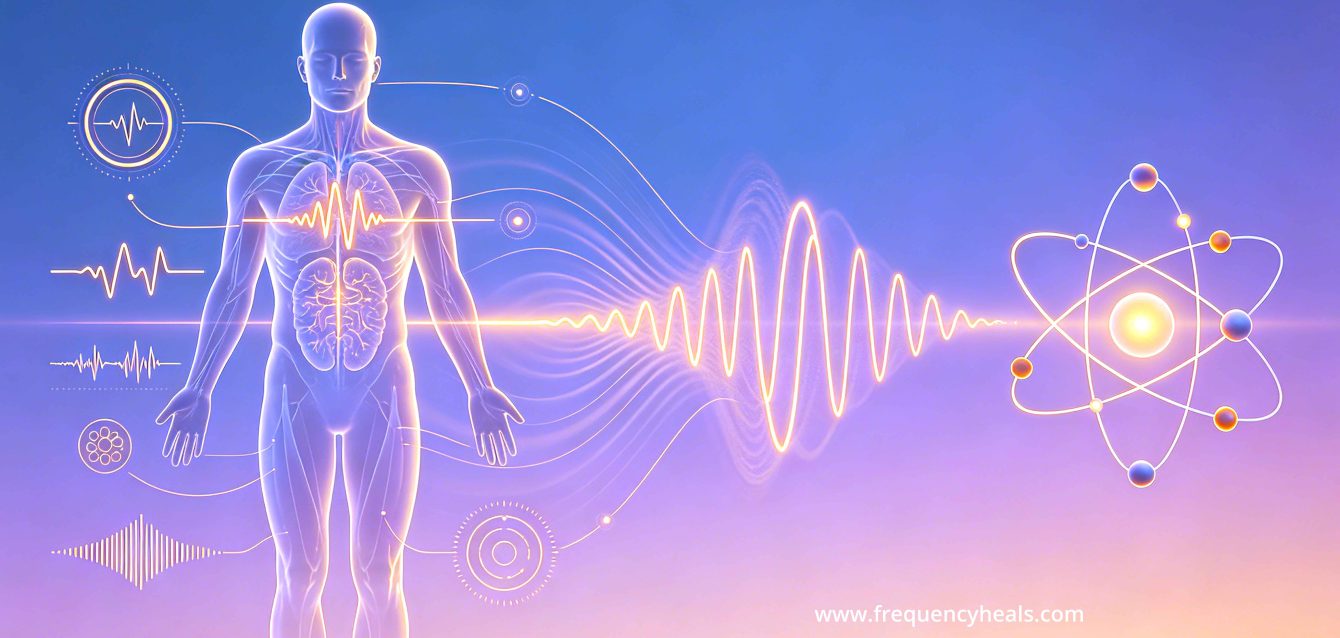
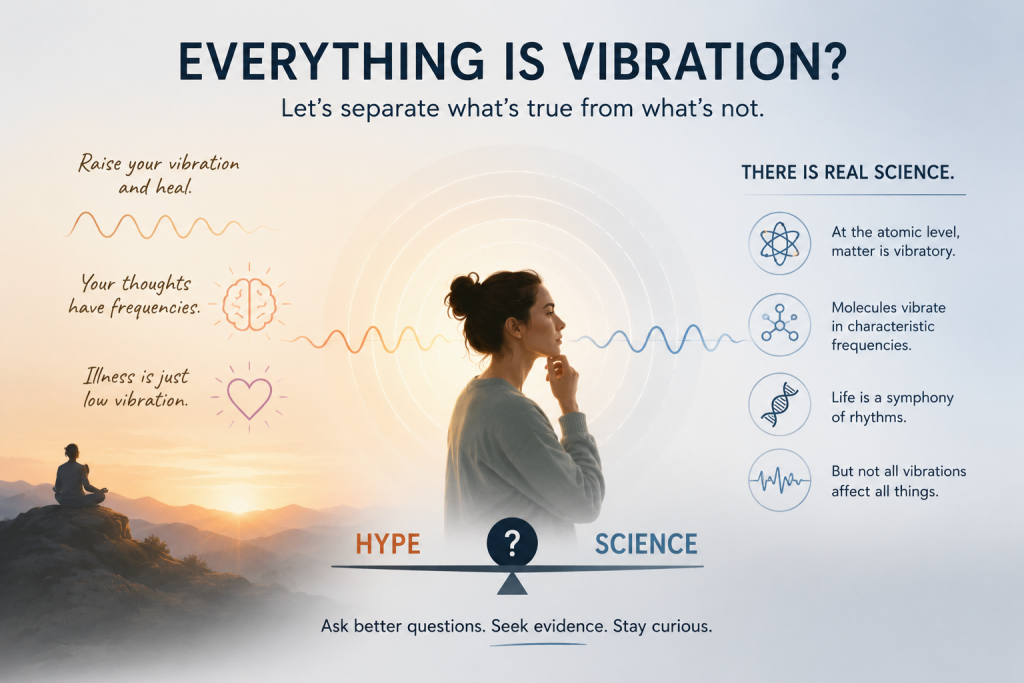
You’ve probably heard the phrase. It shows up in wellness circles, in spiritual traditions, in motivational quotes accompanied by sunrise photographs. “Everything is vibration.” Sometimes it’s paired with equally sweeping claims — that your thoughts have frequencies, that illness is just low vibration, that raising your vibration cures disease.
And if you’re anything like me, your first instinct might be to feel a little wary. The phrase has been stretched so far in so many directions that it can start to feel like it means everything and nothing at the same time.
But here’s the thing: underneath the overuse and the occasional overselling, there is a real idea. A scientifically grounded one. Concepts like vibration, oscillation, and resonance help explain how physical systems respond to patterns and frequencies. From the rhythms found in nature to the broader idea of cosmic resonance, exploring vibration can reveal fascinating connections between the physical world and the patterns that surround us. And it’s worth taking the time to separate what’s actually true from what’s been added on top.
That’s what this article is about. Not to dismiss the phrase, and not to endorse every claim made in its name — but to ask seriously: what does it actually mean? What does physics and biology say? And where does the legitimate science end and the speculation begin?
Where the Idea Comes From — and Why It Isn't New
The idea that matter is fundamentally vibratory in nature is ancient. Ancient Greek philosophers proposed that the world was made of moving particles. Indian philosophical traditions spoke of sound — nada — as a primordial creative force. The Hermetic tradition, popular in the Renaissance, held that vibration was one of the fundamental principles underlying reality.
These weren’t scientific claims in the modern sense. They were philosophical and spiritual intuitions. But they were remarkably prescient about something that physics would eventually confirm through very different methods.
What’s interesting is that modern science arrived at a similar conclusion — that matter at its deepest level is dynamic, oscillatory, wave-like — not through mysticism but through experiment. And the route it took is worth understanding, because it shapes exactly what “everything is vibration” can legitimately mean.
What Physics Actually Says: From Atoms to Quantum Fields
Let’s start at the atomic scale, because this is where the vibratory nature of matter becomes concrete and measurable.
Atoms are not static. The electrons in an atom don’t sit still around the nucleus — they exist in probability distributions, quantum states characterized by specific energy levels and wave functions. When an electron transitions between energy levels, it absorbs or emits electromagnetic radiation at a specific frequency — a frequency so precise that it serves as the basis for atomic clocks, the most accurate timekeeping devices ever made [1].
Even at absolute zero — the coldest temperature physically possible — atoms don’t stop moving. Quantum mechanics demands a residual zero-point energy: a minimum irreducible vibration that cannot be removed from any quantum system [1]. Matter, at its most fundamental, cannot be brought to complete stillness. Motion is not something that happens to matter. It is, in a deep sense, intrinsic to it.
At the molecular scale, this becomes even more tangible. Molecules vibrate — their atoms stretching, bending, and rotating relative to each other at characteristic frequencies determined by their chemical bonds and masses. These vibrational modes are not trivial background noise. They are central to chemistry: the energy of chemical reactions, the way enzymes work, how proteins fold, how DNA transcription proceeds — all of these depend on the vibrational dynamics of molecules [2].
Infrared spectroscopy — a standard analytical chemistry technique — works by shining infrared light at a molecule and measuring which frequencies are absorbed. Different chemical bonds absorb at different frequencies. The result is a vibrational fingerprint that can uniquely identify a molecule. In a very real sense, molecules have characteristic frequencies — and those frequencies are detectable, measurable, and chemically meaningful [2].
Going deeper still: quantum field theory, the most fundamental framework in modern physics, describes all particles not as tiny billiard balls but as excitations of underlying quantum fields. An electron is a quantized vibration of the electron field. A photon is a quantized vibration of the electromagnetic field. In this framework, “everything is vibration” is not a metaphor. It is remarkably close to a literal description of what matter is [1].
The Important Caveat: Levels of Description
Here is where I want to slow down and be careful — because this is where the legitimate physics often gets used to justify claims that don’t actually follow from it.
Yes, at the quantum field level, matter is vibratory. But this doesn’t mean that all vibrations are equivalent, or that influencing one level of vibration automatically influences another. Physics has different levels of description — quantum, atomic, molecular, cellular, organ, whole-organism — and while these levels are connected, they don’t simply collapse into each other.
The vibrational frequency of an electron in a carbon atom has essentially no direct relationship to the frequency of your heartbeat, or the frequency of a sound wave in the room, or the frequency of a thought. These are phenomena at completely different scales, governed by different physical principles, connected by enormously complex chains of causation [3].
This is why the leap from “everything is vibration at the quantum level” to “therefore specific sounds or intentions can directly reprogram your molecular biology” doesn’t actually hold up under scrutiny. The connection between scales is real but it is not simple, not direct, and not easily exploited by applying a vibration at one level and expecting a specific result at another.
What this means practically: the fact that atoms vibrate doesn’t tell you that any particular frequency-based health intervention works. Those claims need their own evidence — at their own level of biological organization — to be evaluated fairly.
What "Vibration" Means at the Biological Level
Setting aside the quantum for a moment, the claim that “everything is vibration” has a much more direct and biologically concrete meaning when applied to living systems — and this is the version that’s most relevant to frequency-based health.
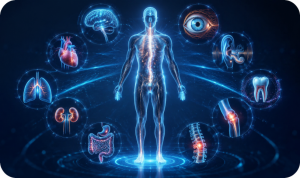
As we’ve explored throughout this series, the body is a deeply rhythmic system. The heart oscillates. The breath oscillates. The brain generates oscillating electrical activity. Cells maintain oscillating membrane potentials. The circadian system oscillates with a roughly 24-hour period. Hormones pulse. The immune system has rhythmic activity patterns. Gut motility follows rhythmic waves [4].
At the cellular level, oscillation is not an accident or a side effect. It’s a fundamental feature of how cells compute, communicate, and regulate themselves. Ion channels open and close rhythmically. Gene expression oscillates across the cell cycle. Calcium signaling inside cells occurs in waves and pulses. Mitochondria — the energy-producing organelles — have oscillating membrane potentials that are coupled to their energy output [4].
In this sense, the body really is a system organized around vibration and oscillation — not metaphorically, but mechanistically. And that’s the meaningful core of the claim, stripped of embellishment.
The Difference Between a Useful Idea and an Unfalsifiable One
One of the things that makes “everything is vibration” tricky as a health claim is that it can be used in two very different ways — and it matters which one you’re encountering.
The first way is as a scientific framework: the body operates through rhythmic, oscillatory processes, and therefore it’s plausible that external rhythmic signals might interact with those processes in measurable ways. This version is specific enough to be tested. It generates predictions. It can be supported or refuted by evidence. This is the version that drives legitimate research in areas like bioacoustics, chronobiology, and neuroscience [3].
The second way is as an unfalsifiable worldview: everything has a vibration, illness is low vibration, healing is raising vibration. This version explains everything and therefore predicts nothing. It can’t be tested because it isn’t specific enough to generate falsifiable predictions. It’s not science — it’s a metaphysical framework, and while metaphysical frameworks can be meaningful and valuable in their own right, they shouldn’t be mistaken for scientific claims [3].
Recognizing the difference matters — both for evaluating specific health claims and for having honest conversations about what frequency-based approaches can and can’t do.
What Ancient Traditions Were Actually Pointing At
I want to spend a moment here being fair to the traditions that gave us this phrase in the first place — because I think they were often pointing at something real, even if their language looks very different from modern scientific terminology.
When ancient Indian philosophy described nada brahma — the universe as sound, as vibration — it wasn’t making a claim about quantum field theory. It was making an observation about the rhythmic, dynamic, interdependent nature of experience and reality. That things are not static. That everything is in motion. That patterns and relationships matter as much as objects.
When traditional healing systems spoke of balancing the body’s energies or restoring harmony — whether in Ayurveda, Traditional Chinese Medicine, or other traditions — they were often describing something that maps, at least partially, onto what modern physiology calls physiological coherence: the coordinated, synchronized functioning of the body’s multiple rhythmic systems [5].
The language is different. The conceptual frameworks are very different. But the underlying observation — that health involves a kind of dynamic, rhythmic balance, and that disruptions to that balance correspond to illness — is shared across traditions that developed independently across thousands of years of human experience. That convergence isn’t proof of anything specific, but it’s worth taking seriously as a signal that these traditions were observing something real about the body.
So What Can We Actually Claim?
Let me try to draw clear lines, because I think they’re genuinely useful.
What is well-supported: matter at the atomic and subatomic level is intrinsically dynamic and wave-like. Molecules vibrate at characteristic frequencies that are chemically and biologically meaningful. Living systems at every scale — from cells to organs to whole organisms — operate through rhythmic, oscillatory processes. External rhythmic signals can, under specific conditions, interact with and influence the body’s own oscillatory systems. Some frequency-based interventions have measurable, reproducible biological effects [4].
What is plausible but not yet fully established: that a wider range of frequency-based approaches — including sound therapy, PEMF, and bioresonance — can be designed to interact with specific biological rhythms in therapeutically useful ways. The conceptual framework is coherent; the evidence for specific protocols varies widely [5].
What is not well-supported: that illness is simply “low vibration” reducible to a single dimension. That specific numerical frequencies correspond universally to specific organs or emotional states. That thoughts or intentions have direct physical frequencies that interact with matter in ways equivalent to acoustic or electromagnetic frequencies. That quantum-level vibration can be directly manipulated by human-scale interventions to produce specific health outcomes [3].
Holding these distinctions doesn’t diminish the field. If anything, it sharpens it — by focusing attention on the claims that deserve serious investigation and letting go of the ones that are more poetry than science.
The Phrase, Rehabilitated
I’ve come to think that “everything is vibration” is a phrase worth keeping — but worth keeping carefully.
As a reminder that matter is not inert. That the body is not a machine made of static parts but a dynamic, rhythmically organized system in constant motion and constant conversation with its environment. That health is not just the absence of structural damage but the coherence and adaptability of the body’s many interlocking rhythms. In this sense, the phrase points at something genuinely important.
What it doesn’t do — what it can’t do — is replace the specific, careful work of understanding which vibrations, at which frequencies, through which mechanisms, produce which effects in which systems. That work is what science is for. And the good news is that it’s being done — gradually, carefully, imperfectly, as all good science is.
The phrase is a starting point, not a conclusion. An invitation to curiosity, not a substitute for it. And approached that way — held lightly, questioned generously — it opens a door into some of the most interesting territory in contemporary biology and medicine.
References
- [1] Feynman, R. P., Leighton, R. B., & Sands, M. (2011). The Feynman Lectures on Physics, Vol. III: Quantum Mechanics. Basic Books. [Chapters on quantum states, wave functions, and zero-point energy]
- [2] Atkins, P., & de Paula, J. (2014). Physical Chemistry: Quanta, Matter, and Change (2nd ed.). Oxford University Press. [Chapters on molecular vibration and infrared spectroscopy]
- [3] Pigliucci, M., & Boudry, M. (Eds.). (2013). Philosophy of Pseudoscience: Reconsidering the Demarcation Problem. University of Chicago Press.
- [4] Lloyd, D., & Rossi, E. L. (Eds.). (2008). Ultradian Rhythms from Molecules to Mind: A New Vision of Life. Springer.
- [5] McCraty, R., Atkinson, M., Tomasino, D., & Bradley, R. T. (2009). The coherent heart: Heart-brain interactions, psychophysiological coherence, and the emergence of system-wide order. Integral Review, 5(2), 10–115.







Comments
Prior to this message I sent you an email.
Everything here made perfect sense.
Hi Margaret 💜
Thank you for letting us know 😊
We’re glad to hear everything was sent successfully. We appreciate you reaching out and being part of our community.
Wishing you all the best on your frequency journey 💙✨
I’m wanting to sign in but can’t find how to do that
Hi Jo Hudson 💜
Thank you so much for your comment. 😊
You can subscribe to receive our educational emails and the latest frequency updates here:
📩 https://app.monstercampaigns.com/c/lblhtxxcfqvaulepmgdx
We’re excited to have you with us and hope our content helps you learn and explore frequencies with confidence.
Wishing you all the best on your wellness journey. 💙✨
My name is Umjima l need healing and money l live with my childern
Hi Umjima 💜
Thank you for sharing with us. We’re sending you our warmest wishes and hope you find moments of peace, strength, and support during this time. 🙏
If you’re interested in exploring frequency sessions, you may find our emotional wellness resources here:
🌿 Emotional Frequency Sessions
https://www.frequencyheals.com/video-category/emotional/
You may also explore this frequency session:
✨ Miraculous Windfall of Money | Healing Frequencies
https://www.youtube.com/watch?v=74DkfSgvbMs
We hope these resources bring you a sense of positivity, relaxation, and encouragement as part of your personal journey. 💙