

I want to start with a confession: I used to roll my eyes at the idea that something as gentle as a sound, a hum, or a low-level vibration could meaningfully affect the human body. It seemed like wishful thinking — the kind of claim that sounds poetic but falls apart the moment you ask for the mechanism.
Then I started actually reading the research. And I had to quietly update my assumptions.
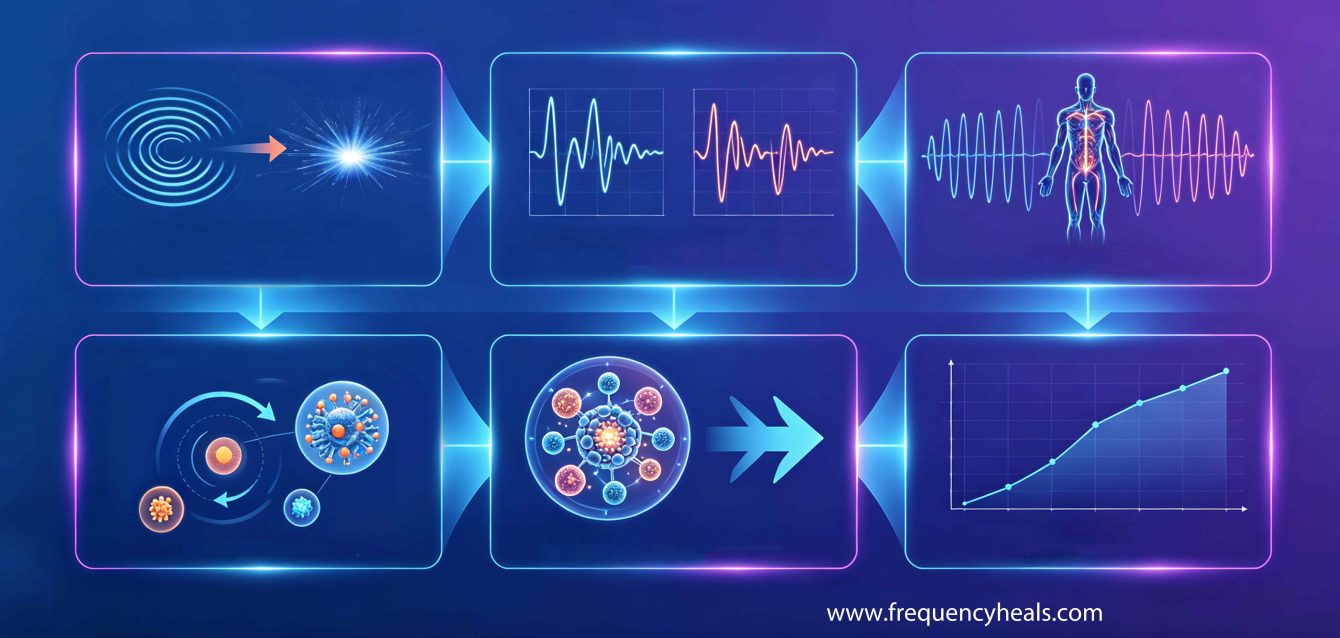
Not because the claims of the wellness world turned out to be exactly right — some of them are still way out ahead of the evidence. But because the underlying physics and biology turned out to be genuinely fascinating, and genuinely real. Small vibrations can, under the right conditions, have effects that seem wildly disproportionate to their size. This is the basic principle behind resonance — a phenomenon where systems can respond strongly when exposed to vibrations at the right frequency. And understanding why requires us to think a little differently about how complex systems work.
The Intuition We Start With — and Why It's Incomplete
Our everyday intuition about cause and effect is pretty Newtonian. Big forces cause big effects. Small forces cause small effects. You push harder, the thing moves more. It’s a reasonable model for a lot of situations — but it breaks down when you’re dealing with systems that have their own internal dynamics.
A system with internal dynamics isn’t just a passive object waiting to be pushed around. It has its own rhythms, its own preferred states, its own way of responding to input. And for systems like this, the relationship between input size and effect size can be surprisingly nonlinear.
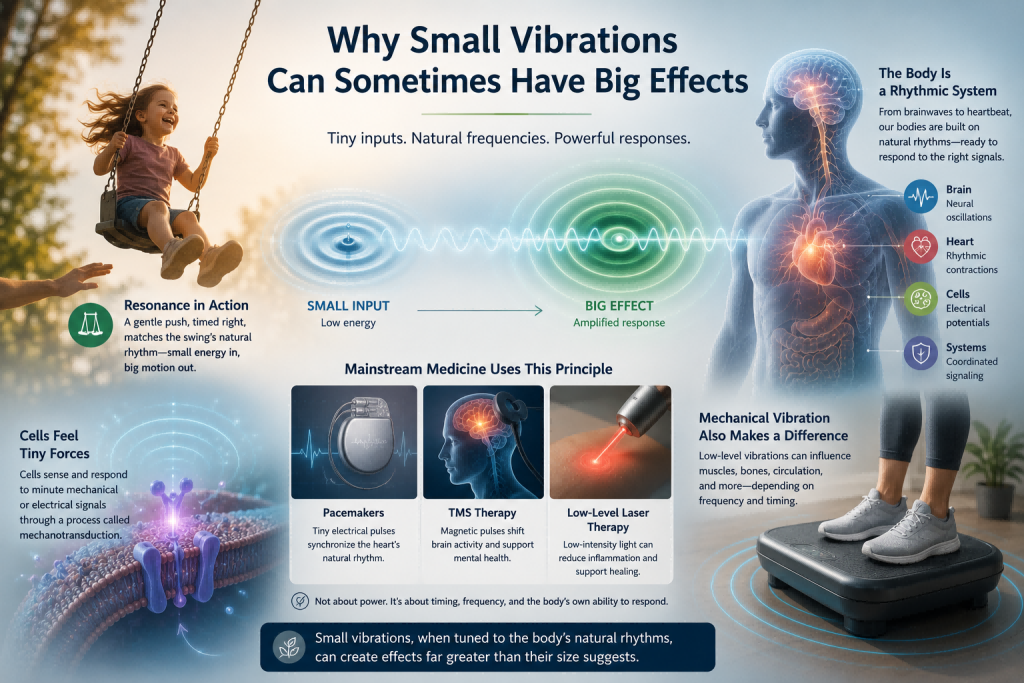
The clearest everyday example: a child on a swing. The swing has a natural rhythm — a frequency at which it naturally wants to oscillate. If you push in sync with that rhythm, even a very gentle push adds up, each one amplifying the previous motion. A few small, well-timed nudges and the child is soaring. A large, mistimed shove might actually disrupt the motion rather than amplify it.
This is resonance — and it’s one of the most important concepts in physics, biology, and, as it turns out, medicine. We’ll explore it in depth in the next article. But the core principle is already visible in that playground: timing and frequency matter more than brute force.
The Body Is Not a Passive Object
Here’s where this gets directly relevant to the human body.
The body is a richly rhythmic system. Your heart beats at a rhythm. Your neurons fire in coordinated oscillations. Your cells maintain oscillating electrical potentials across their membranes. Your immune cells, your gut, your endocrine system — all of them operate through rhythmic, time-dependent signaling processes.
This means the body is, in a real physical sense, more like the swing than like an inert object. It has natural frequencies. It has preferred rhythmic states. And that opens the door to the possibility that small external inputs — if they’re timed and tuned appropriately — might have effects that outstrip their apparent physical magnitude.
This isn’t fringe speculation. It’s the basis of several well-established and mainstream medical technologies.
What Mainstream Medicine Already Knows About This
Cardiac pacemakers are perhaps the most striking example. A modern pacemaker delivers electrical pulses in the range of a few microjoules — vanishingly small amounts of energy. Yet those tiny, precisely timed signals are enough to organize the rhythmic activity of the entire heart. The key isn’t the energy level. It’s the timing, and the fact that the heart’s own electrical system is primed to respond to rhythmic input [1].
Transcranial magnetic stimulation, or TMS, is another. A magnetic pulse is delivered through the skull — non-invasively, with no direct physical contact with brain tissue — and it can measurably shift neural activity in targeted brain regions. The effect on individual neurons from a single pulse is tiny. But applied rhythmically and repeatedly, TMS can influence mood, reduce symptoms of depression, and alter cortical excitability in ways that persist well beyond the session itself [2]. The brain’s oscillatory nature means it responds to rhythm, not just magnitude.
Low-level laser therapy — using light at intensities far too low to heat tissue — has been shown in multiple studies to influence cellular metabolism, reduce inflammation, and accelerate healing in certain contexts [3]. The proposed mechanism involves photons interacting with mitochondrial enzymes and triggering downstream signaling cascades. Again: tiny input, disproportionate effect, mediated through the cell’s own internal machinery.
None of these are fringe treatments. They’re used in hospitals and clinics around the world. And what they share — what I find quietly remarkable — is this: in each case, the effect doesn’t come primarily from the energy of the intervention. It comes from the interaction between a small, precisely delivered signal and a biological system that’s already organized to respond to that kind of input.
Mechanical Vibration and the Body
Mechanical vibration — actual physical oscillation transmitted through the body — is another area where small inputs can produce meaningful physiological effects.
Whole-body vibration therapy, for instance, uses a vibrating platform to deliver low-frequency mechanical oscillations through the body. Research has investigated its effects on muscle strength, bone density, circulation, and neuromuscular coordination [4]. The studies are mixed, and the field is still working out which frequencies, intensities, and durations are most useful for which populations. But the fact that measurable physiological changes occur in response to low-level mechanical vibration is not in dispute.
At a cellular level, this starts to make intuitive sense. Cells are not rigid. They’re mechanically active — constantly sensing and responding to physical forces through a process called mechano-transduction. Specialized proteins in cell membranes act as force sensors, translating mechanical deformation into biochemical signals [4]. The cell, in other words, is listening. And it’s listening with extraordinary sensitivity.
Research has shown that even very small mechanical stimuli — well below what you’d feel consciously — can influence gene expression, protein synthesis, and cellular signaling pathways. The mechanism isn’t mysterious: it’s the ordinary machinery of cell biology, being activated by a physical input it’s designed to detect [4].
The Question of Accumulation
Another reason small vibrations can have large effects is simply accumulation over time.
We know this intuitively with sound: a jackhammer outside your window for one afternoon is annoying. The same noise every day for years contributes to real hearing damage and elevated cardiovascular risk. Chronic low-level noise pollution has been associated with increased rates of hypertension, sleep disruption, and metabolic dysregulation — effects that seem disproportionate to the modest energy levels involved [5].
But accumulation works in positive directions too. Repeated exposure to coherent rhythmic signals — through consistent practices like meditation, paced breathing, music therapy, or rhythmic sound — appears to produce neuroplastic changes over time. The nervous system isn’t just responding in the moment. It’s adapting its baseline patterns [2].
This is actually one of the more interesting findings in the research on sound-based practices: the effects aren’t just acute. Regular, sustained engagement with rhythmic auditory stimulation appears to shift the set point of autonomic nervous system function — gradually nudging the system toward greater resilience and adaptability [2].
What This Means — and What It Doesn't
I want to be careful here, because the history of wellness culture is full of examples where a real and interesting phenomenon gets stretched into something much more than the evidence supports.
The fact that small vibrations can have big effects doesn’t mean that any vibration, at any frequency, applied in any way, will produce meaningful therapeutic results. The principle is real; the applications vary enormously in their evidence base. Timing, frequency specificity, duration, and the state of the biological system receiving the input all matter — a lot.
What the science does support is a more nuanced picture than either the skeptic or the true believer tends to hold. On one side: no, a gentle sound or vibration is not inherently trivial or too small to matter. The body is organized in ways that make it genuinely responsive to rhythmic input at low energy levels. On the other side: not all frequency-based practices are equal, the research quality varies widely, and enthusiasm should be calibrated to evidence.
The most honest version of where the science stands is probably this: we are in early days of understanding exactly how the body’s rhythmic systems respond to external vibratory input. The mechanisms are real. The effects are sometimes measurable and sometimes not. And the gap between what’s established and what’s claimed in many corners of the wellness world remains significant.
That’s not a reason to dismiss the field. It’s a reason to stay curious, stay honest, and keep asking good questions.
A Thread to Pull On
What I keep coming back to — the thing that shifted my own thinking on all of this — is the realization that the body’s sensitivity to rhythmic input isn’t a bug or a quirk. It’s a feature. It’s how the body’s regulatory systems are designed to work.
Cells talk to each other through oscillating signals. Organs coordinate through rhythmic timing cues. The nervous system organizes its activity into frequency bands. When you appreciate how deeply rhythm is woven into the body’s operating logic, the idea that carefully applied external rhythms might be able to influence that system stops seeming surprising. It starts seeming almost obvious.
Almost. The details still matter enormously. But the foundation — the reason why small vibrations deserve to be taken seriously — is solid.
In another article, we’ll go deeper into the concept that ties all of this together: resonance. What it actually is, how it works in the physical world and in the body, and why it might be the key to understanding both the promise and the limits of frequency-based approaches to health.
References
- [1] Ellenbogen, K. A., & Kaszala, K. (Eds.). (2014). Cardiac Pacing and ICDs (6th ed.). Wiley-Blackwell.
- [2] Lefaucheur, J. P., André-Obadia, N., Antal, A., Ayache, S. S., Baeken, C., Benninger, D. H., … & Garcia-Larrea, L. (2014). Evidence-based guidelines on the therapeutic use of repetitive transcranial magnetic stimulation (rTMS). Clinical Neurophysiology, 125(11), 2150–2206.
- [3] Hamblin, M. R. (2016). Shining light on the head: Photobiomodulation for brain disorders. BBA Clinical, 6, 113–124.
- [4] Ingber, D. E. (2006). Cellular mechanotransduction: Putting all the pieces together again. FASEB Journal, 20(7), 811–827.
- [5] Münzel, T., Gori, T., Babisch, W., & Basner, M. (2014). Cardiovascular effects of environmental noise exposure. European Heart Journal, 35(13), 829–836.








Comments
I have a sound generated where is there a book of hw sounds
Hi Phillip, thank you for your message. 😊
Just to make sure we understand correctly — are you asking for:
books/resources about healing frequencies and sound, or
information on how to use a sound/frequency generator?
We’d be happy to point you in the right direction. 🌿
I am just beginning to learn about sound & vibration, I find it interesting. I hope and pray most of it is true. Just to think a vibration can have the power to heal us, by stimulating things in our body.
Hi Gerry 💜
Thank you for sharing your thoughts with us! 😊
It’s wonderful to see you exploring the world of sound and vibration. Sound and frequencies have been part of human experiences for centuries, from music and meditation to relaxation practices. 🎧🌿
Many people enjoy frequency-based audio as a way to support relaxation, mindfulness, focus, and their personal wellness routines. Everyone’s experience can be different, so we encourage you to explore with curiosity and find the sessions that feel most meaningful to you. 💙
If you’d like to learn more about the basics of frequencies, you can start here:
🌿 Science of Frequency
https://www.frequencyheals.com/science-of-frequency/
Thank you for joining us on this journey of exploring sound and vibration! ✨