The body is an orchestra
“The body is a unit, though it is composed of many parts. And though its parts are many, they all form one body…”
— 1 Corinthians 12:12
Yet somewhere along the way, the body was dissected, compartmentalized and divvied up by the specialists of conventional medicine. We no longer viewed the body as a whole but as a collection of disassociated parts. This has led to symptom-oriented, conventional medicine that neglects to view the human body as a finely-tuned, interconnected ensemble of complex systems, much like an orchestra of many musicians. Frequency healing is a full-body approach that takes all our body’s “musicians” into consideration so that everything works in harmony. Sound frequency modalities work as “tuning forks” that bring harmony among the discord, raising the body’s vibrations to get the energy flowing.
Binaural beats- sound frequency healing’s “kid brother”
Those who know about sound frequencies as healing tools will probably be familiar with time-tested, ancient modalities like Gregorian chants, singing bowls and Solfeggio frequencies.
Here, we’re going to explore binaural beats, their mysterious “kid” brother (only about 200 years old). In a nutshell, a binaural beat is an auditory illusion made by playing two tones with slightly different frequencies that “blend” in the brain to form a third frequency, which in turn, creates a soothing bodily response. This blending, known as brainwave entrainment, is an effective way to “train”, or gently rewire, the brain to achieve positive outcomes.
Whereas other sound frequency techniques can directly affect the whole body, binaural beats focus on the brain to bring the body to a calm state, creating an ideal environment for full-body healing.
A quick primer on neuroplasticit
The brain is is not set in stone: it constantly adapting to various stimuli. Through lived experiences, learning, external stimuli and movement, synapses are formed in the brain, like little bridges of information. When repeated over and over, these bridges get reinforced, whether it be for a critical motor skill or a negative thought pattern. Just like certain instruments in an orchestra that might create discord if not guide correctly, negative thought patterns can influence our whole being if left to self-perpetuate.
Fortunately, our brains are highly adaptive. This capacity to rewire the brain is known as neuroplasticity, which can be achieved through activities like meditation, yoga, or being exposed to new things. Now we have a powerful newcomer to engaging neuroplasticity: binaural beats.
OK, so how do binaural beats work?
An easily accessible aid in sound frequency healing, binaural beats deliver specific frequencies that stimulate the brain, triggering neural firing across multiple regions simultaneously. Over time, these repeated activations strengthen communication between brain cells, literally reshaping our brains’ structure and function. In short, they are doing the same job as meditation, but with less personal engagement.
Here is an example of how it works.
Placing a headset that plays a separate tone in each ear, the brain will respond by creating an independent illusionary tone that equals the difference between the two received tones. For instance, to induce a frequency for pain relief, a tone of 400 Hz can be presented to one ear and a tone of 412 Hz to the other, which creates a perceived tone that fluctuates in amplitude with a frequency of 12 Hz, stimulating the brain’s electrical response to pain.
Getting to know your brainwaves
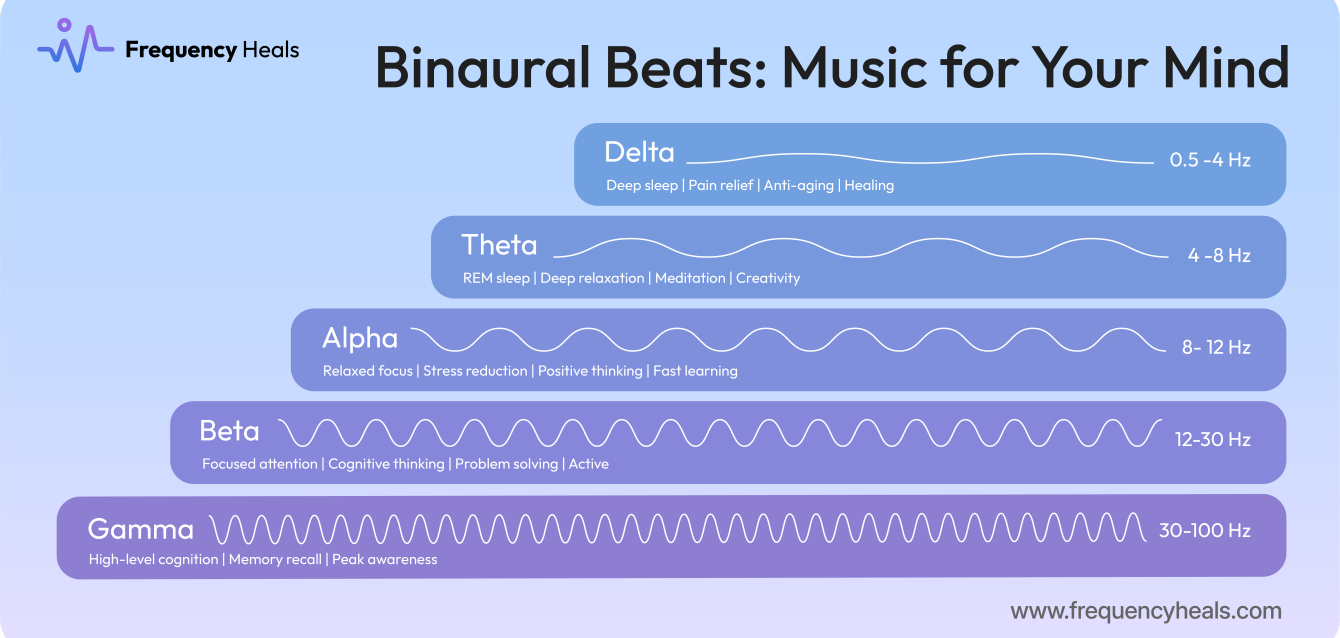
The beauty of using binaural beats is in its simplicity: all you have to do is put on a headset and choose the frequency combination that will produce the desired outcome. It’s the difference in the right and left frequencies that you’re aiming for, which corresponds to the delta, theta, alpha, beta, or gamma brainwave states associated with various mental states and physiological responses. To start preparing your frequency healing toolkit, it’s good to know the 5 brainwave states, their benefits, and suggested settings to use them in:
Delta Waves (0.5 – 4 Hz)
Delta waves are the slowest brainwave frequencies and are crucial for deep, restorative sleep, which is essential for physical recovery and overall health. They can also assist in pain relief and recovery from trauma. Find a quiet space to lie down comfortably while you listen. Allow yourself to drift into a deep state of relaxation or even sleep.
Theta Waves (4 – 8 Hz)
Theta waves, often associated with light sleep and deep meditation states, promote creativity, intuition, and emotional processing/internal conflict resolution as well as providing an ideal environment for healing. Listen to theta binaural beats during meditation or journaling sessions.
Alpha Waves (8 – 12 Hz)
Alpha waves are present during relaxed wakefulness and are often linked with states of calmness and alertness. Binaural beats in this range help foster a balanced state where relaxation meets focus, reducing anxiety, improving concentration/retention of information and boosting mood levels. Incorporate alpha binaural beats into your daily routine by listening during work or study sessions.
Beta Waves (12 – 30 Hz)
Beta waves correspond with active thinking and alertness, enhancing productive energy, problem resolution, and focus. Use beta binaural beats in moderation during tasks that require high concentration or strategic planning sessions.
Gamma Waves (30 – 100 Hz)
Gamma waves represent the fastest brainwave activity associated with heightened perception and awareness. They enhance cognitive functioning, awareness, memory recall, and problem-solving in addition to supporting emotional stability. Listen to gamma binaural beats for short periods of time while engaging in creative activities or deep intellectual exploration.
Exploring binaural beats on your own
If you’re still a little lost on where to start, here is our easy-to-use tool to explore binaural beats and incorporate them into your self care routine:
- Use comfortable quality headphones that block out external noise. This will allow you to hear more subtle tones.
- Select a calm space free from distractions so you can focus on the beats
- Start with a medium volume level and adjust it to where it is comfortable for you. Find that sweet spot where you hear the beats clearly.
- Choose the right time that corresponds with what you wish to achieve from the session. For example, the morning is best for alertness, the afternoon for sustained focus, the evening is for relaxation and the night is for deep sleep. Other desired outcomes will have their own ideal time, but no matter when you choose to partake in a session, it’s best to do it an optimal setting.
- Start with short sessions of 10-15 minutes and work your way up as your brain adapts to the stimulation. Stop the session if you feel any discomfort or overstimulation.
- Fit your sessions into a routine that you can stick to. Consistency is key as this is what reinforces healing neural pathway.
- Select the frequency that best matches your goals. Our tool can assist you in finding what you need.
- Incorporate activities like breath work and meditation into the sessions for enhanced brainwave entrainment.
- Have Realistic Expectations. Some results take time and others may have actually occurred more subtly.
Nevertheless, it’s important to understand that the biggest benefit of binaural beats is probably more subtle than what we are used to: they help create conditions that more conducive to healing. By taking into account not just the issue at hand, but the entire setting and emotional state that the patient is in, we can achieve better outcomes in less time.
Modalities such as binaural beats are thus essential in a healing environment.
Resources:
- 1. The neuroplastic brain: current breakthroughs and emerging frontiers – ScienceDirect
- 2. Magazine Article 1973 (Scientific American) – Auditory Beats in the Brain – Gerald Oster : Scientific American
- 3. Binaural Beats and Brain Repatterning: Sound as a Neuroplasticity Tool – Zone Life
- 4. Does brain entrainment using binaural auditory beats affect pain perception in acute and chronic pain?