

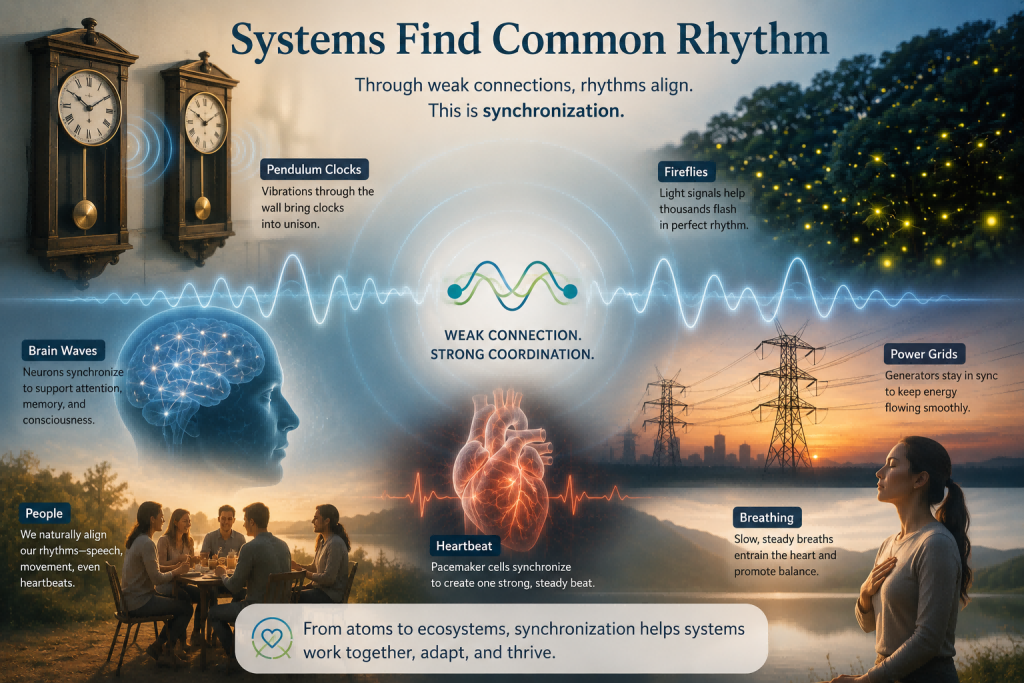
In 1665, the Dutch physicist Christiaan Huygens noticed something peculiar about two pendulum clocks he had mounted on the same wall. Left on their own, they swung at slightly different rates. But after a period of time — a few hours, typically — they always ended up swinging in perfect unison, their rhythms locked together as if by some invisible agreement.
Huygens was baffled. He called it ‘an odd kind of sympathy.’ It took physicists another three centuries to fully understand what he was seeing.
What he had discovered — without the language to describe it — was spontaneous synchronization. The tiny vibrations each clock transmitted through the shared wall were enough to gradually pull both pendulums into step with each other. This relationship between vibration, timing, and response is closely connected with the broader principles of resonance. Two oscillating systems, connected by even a very weak physical link, had found a common rhythm.
This phenomenon — now called entrainment, or mutual synchronization — turns out to be one of the most fundamental and widespread behaviors in nature. And once you understand it, a great deal about biological health, rhythmic coordination, and yes, frequency-based practices starts to make much more sense.
What Synchronization Actually Means
Let’s be precise about what we mean, because ‘synchronization’ gets used loosely in a lot of wellness writing.
Two oscillating systems are synchronized when their rhythms become coordinated — not necessarily identical in frequency, but locked into a stable relationship. The most common form is phase locking, where the two systems oscillate at the same frequency with a consistent phase relationship (they peak together, or one consistently leads the other by the same interval). Another form is frequency entrainment, where one oscillator gradually shifts its frequency to match another [1].
Synchronization doesn’t require a large force. It doesn’t require the systems to be identical. What it requires is some form of coupling — a channel through which one system’s rhythm can influence the other. The coupling can be mechanical (vibrations through a shared surface), acoustic (sound waves through air), electromagnetic (light or electrical signals), or chemical (hormones and neurotransmitters traveling through the bloodstream or across synapses). Once that coupling exists, and once the systems’ natural frequencies are close enough to each other, synchronization tends to emerge spontaneously [1].
This is the part that I find genuinely astonishing: synchronization is not imposed from outside. It arises from the dynamics of the coupled systems themselves. Given the right conditions, it just… happens.
Synchronization in the Physical World
Beyond Huygens’ clocks, spontaneous synchronization appears in some striking and sometimes counterintuitive places.
Fireflies in Southeast Asia. In certain forest regions of Thailand and Malaysia, thousands of fireflies gather in trees at dusk and begin flashing — initially at random, each on its own schedule. Over the course of minutes, they begin to synchronize. And then, in what appears almost orchestrated, an entire tree full of fireflies pulses in unison, visible from hundreds of meters away. No single firefly is leading. No conductor is organizing them. The synchronization emerges from each firefly adjusting its flashing rhythm slightly in response to the flashes it sees around it — a process of mutual entrainment through light signals [2].
Metronomes on a shared surface. A modern version of Huygens’ observation: place several metronomes set to the same approximate tempo on a freely moving platform — a board resting on two rolling cylinders, for instance — and start them at different phases. Within a minute or two, they synchronize. The tiny mechanical vibrations each metronome transfers to the platform are enough to gradually pull all of them into phase alignment. Remove the coupling — bolt the platform to a rigid surface — and the synchronization doesn’t occur [1].
Power grids. The alternating current in an electrical power grid oscillates at a precise frequency — 60 Hz in North America, 50 Hz in much of the rest of the world. Every generator feeding the grid must stay synchronized to this frequency. When a large power plant suddenly disconnects, the remaining generators must dynamically adjust to maintain synchronization. This is an engineered, managed version of the same phenomenon — and its failure is what causes large-scale blackouts [3].
Synchronization in Living Systems
Biology is deeply saturated with synchronization phenomena — at every scale from the molecular to the behavioral.
The heartbeat itself. The heart’s rhythmic contraction depends on the synchronized firing of hundreds of thousands of cardiac pacemaker cells in the sinoatrial node. Each of these cells is an autonomous oscillator — it would fire on its own, at its own rate, if isolated. But together, coupled through electrical gap junctions, they synchronize their firing to produce a single, coordinated wave of electrical activation that sweeps across the heart and triggers the unified contraction we recognize as a heartbeat [4]. The heartbeat is not a top-down command. It’s an emergent synchronization of many coupled oscillators.
Neural oscillations and brain function. The brain generates rhythmic electrical activity — the brainwaves we’ve discussed in earlier articles — and a great deal of current neuroscience research focuses on how different brain regions synchronize their oscillations during different cognitive tasks. Working memory, attention, perception, and even consciousness itself appear to involve the dynamic synchronization and desynchronization of neural oscillators across the brain [3]. When neural synchronization breaks down in specific ways, it’s associated with conditions including epilepsy, schizophrenia, and certain forms of cognitive decline.
Circadian synchronization across cells. It is to be noted that virtually every cell in the body has its own internal clock. What’s remarkable is how these trillions of individual cellular oscillators stay coordinated with each other and with the external environment. The master clock in the suprachiasmatic nucleus sends timing signals — through neural pathways, hormonal rhythms, and temperature cycles — that entrain the peripheral clocks in the liver, gut, heart, skin, and every other tissue. It’s a cascading synchronization: the environment entrains the master clock, which entrains the peripheral clocks, which coordinate local cellular rhythms [4].
Menstrual synchrony and social rhythms. The idea that women living together tend to synchronize their menstrual cycles — sometimes called the McClintock effect — has been debated in the literature for decades, with mixed findings. What’s not debated is that biological rhythms in humans are influenced by social contact, light exposure, and behavioral patterns shared between people [2]. We are not rhythmically isolated organisms. We entrain to each other, to schedules, to light, to the behaviors of those around us.
The Millennium Bridge
Let’s take the example of Millennium Bridge collapse to understand the concept of resonance in architecture. It’s worth the attention now, because it’s also a perfect example of spontaneous human synchronization.
When the bridge began to sway — initially due to random coincidences in pedestrian footfall — walkers unconsciously adjusted their gait to stay balanced on the moving surface. This adjustment happened to make their steps more synchronized with each other and with the bridge’s swaying motion. More synchronized steps created stronger periodic forces, which amplified the sway further, which caused more gait adjustment, which caused more synchronization [3].
No one decided to synchronize. No one was trying to make the bridge fail. The synchronization emerged automatically from the coupled dynamics of the crowd and the structure — a perfect, somewhat alarming illustration of how spontaneous synchronization can amplify beyond expectations when the coupling is strong enough and the frequencies are close enough.
What Makes Biological Synchronization Healthy — or Unhealthy
Not all synchronization is beneficial. In the body, the line between healthy coordinated rhythm and pathological locked-in pattern is genuinely important.
Healthy biological synchronization tends to be flexible. The heart and breath synchronize, but not rigidly — they maintain their coupling loosely enough to adapt to changing demands. Neural oscillators synchronize during specific tasks but can rapidly decouple and re-form different patterns as circumstances change. This flexible, dynamic synchronization is associated with resilience and adaptability [4].
Rigid, inflexible synchronization is another story. In epilepsy, for instance, large populations of neurons fall into abnormally tight synchrony — a pathological state where the normal flexible dynamics of neural oscillation break down and the brain gets locked into a repetitive, high-amplitude pattern. The seizure is, in a sense, too much synchronization — coordination that has lost its appropriate flexibility [3].
This is a useful nuance for thinking about frequency-based health practices. The goal isn’t to maximize synchronization across all systems. It’s to support the kind of flexible, adaptive coupling that allows the body’s regulatory network to function well — to synchronize when coordination is needed and to decouple fluidly when flexibility is required.
External Rhythms as Entrainment Signals
Here’s where everything in this article connects directly to the broader conversation we’ve been building.
If biological systems are already organized to synchronize through weak coupling — if the heartbeat itself is an emergent synchronization of thousands of pacemaker cells, if the brain coordinates through dynamic oscillatory coupling, if the body’s circadian system entrains to external light signals — then the idea that carefully chosen external rhythms might serve as entrainment signals for the body’s own regulatory systems is not a stretch. It’s a natural extension of the same principles [1].
Slow, paced breathing at around five to six breaths per minute doesn’t just relax you in some vague way. It creates a rhythmic input that entrains the cardiovascular system toward its resonant frequency, pulling heart rate variability, blood pressure oscillations, and respiratory rhythm into a state of coherent synchronization. This has been measured, replicated, and is well-understood mechanistically [4].
Rhythmic auditory stimulation — whether through binaural beats, drumming, or structured music — provides a temporal reference signal that neural oscillators can entrain to. The effect isn’t guaranteed and isn’t uniform across individuals, but it’s real enough to be the subject of serious neuroscience research [2].
Even social rhythms matter. Sharing meals at consistent times, maintaining regular sleep schedules, spending time with people whose biological rhythms are stable — all of these can serve as weak entrainment signals that help anchor the body’s own oscillatory systems. The coupling mechanisms are subtler here, but the principle is the same [4].
Bringing It Together
We’ve come quite a distance from Huygens’ puzzled observation of his clocks on the wall.
What he was seeing — and what three centuries of physics and biology have since clarified — is that oscillating systems naturally tend toward synchronization when they’re weakly coupled and when their frequencies are close. This isn’t a special property of clocks or pendulums. It’s a property of oscillating systems in general. And because the body is made of oscillating systems at every level — cells, organs, neural networks, hormonal rhythms — synchronization is not something that happens to it occasionally. It’s something the body does, constantly, as part of its basic regulatory logic.
Understanding this changes how you might think about frequency-based health practices. They’re not asking the body to do something foreign. They’re offering it rhythmic reference signals of the kind it’s already designed to respond to and entrain with.
Whether those signals come from a carefully paced breath, a rhythmic sound, a vibrating surface, or something more technologically sophisticated — the underlying mechanism is the same one Huygens accidentally demonstrated in 1665. Weak coupling. Close frequencies. And the remarkable, spontaneous tendency of rhythmic systems to find a common beat.
References
- [1] Strogatz, S. H. (2003). Sync: The Emerging Science of Spontaneous Order. Hyperion. [Comprehensive, accessible account of synchronization phenomena across physics, biology, and social systems]
- [2] Buck, J., & Buck, E. (1976). Synchronous fireflies. Scientific American, 234(5), 74–85.
- [3] Uhlhaas, P. J., & Singer, W. (2006). Neural synchrony in brain disorders: Relevance for cognitive dysfunctions and pathophysiology. Neuron, 52(1), 155–168.
- [4] Lehrer, P. M., & Gevirtz, R. (2014). Heart rate variability biofeedback: How and why does it work? Frontiers in Psychology, 5, 756.
- [5] Reppert, S. M., & Weaver, D. R. (2002). Coordination of circadian timing in mammals. Nature, 418(6901), 935–941.





Comments
How interesting.Thankyou for all you do.Love & Light.
Thank you so much, Jay 😊 We truly appreciate your kind words and support. Sending love and light back to you ✨