Have you ever noticed your dog lifting its ears before a distant rumble of thunder even registers to your human senses? Or perhaps you’ve watched your cat instantly react to a sound that occurred completely outside your auditory range. Our animal companions live in a world dictated by a hidden symphony of frequencies. And their senses are finely tuned biological receptors, capturing vibrations that we routinely miss. To understand the basic principles behind this approach, explore what frequency healing means and how frequency-based practices are used.
Because animals are so profoundly sensitive to their energetic and acoustic environments, they are also the most receptive candidates for vibrational medicine.

At Frequency Heals, we believe that the journey to wellness isn’t just for humans. A solution to consider is pet frequency healing support, which provides a gentle, non-invasive, and science-backed way to restore harmony to your pet’s body and mind.
What Exactly is "Pet Frequency Healing Support"?
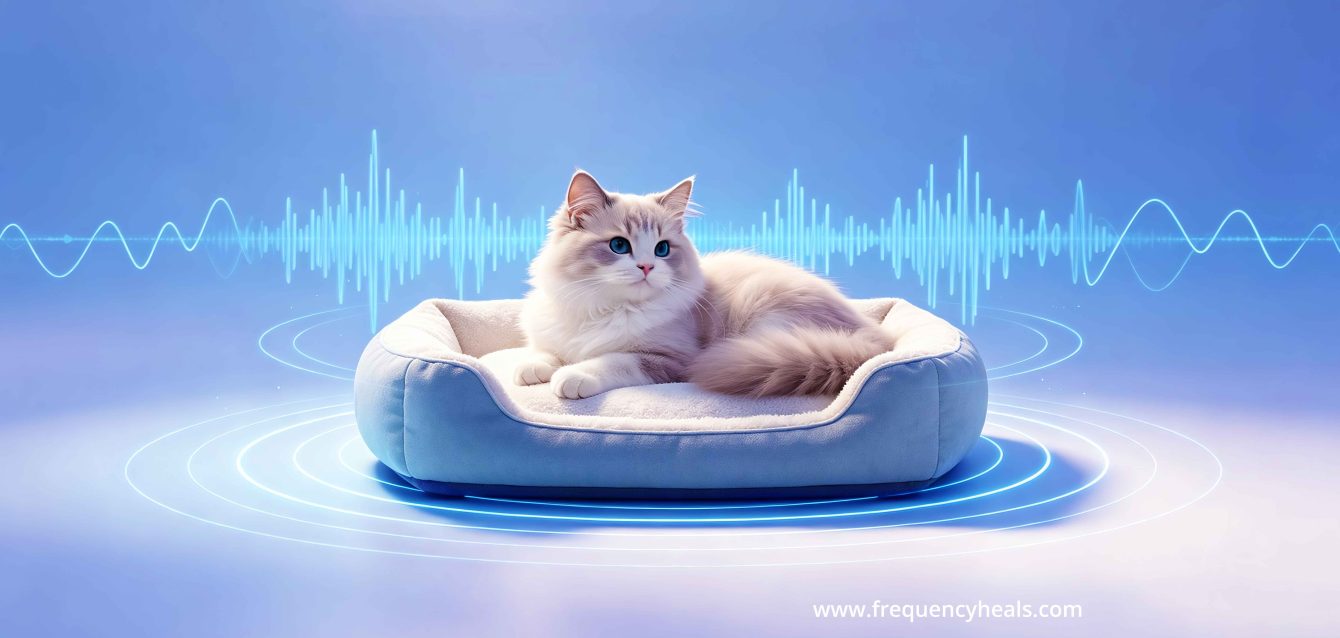
When we speak of pet frequency healing support, we are not talking about complex medical procedures or forced interventions. Instead, it refers to the intentional introduction of specific, low-frequency soundscapes into an animal’s living area to create a restorative acoustic environment.
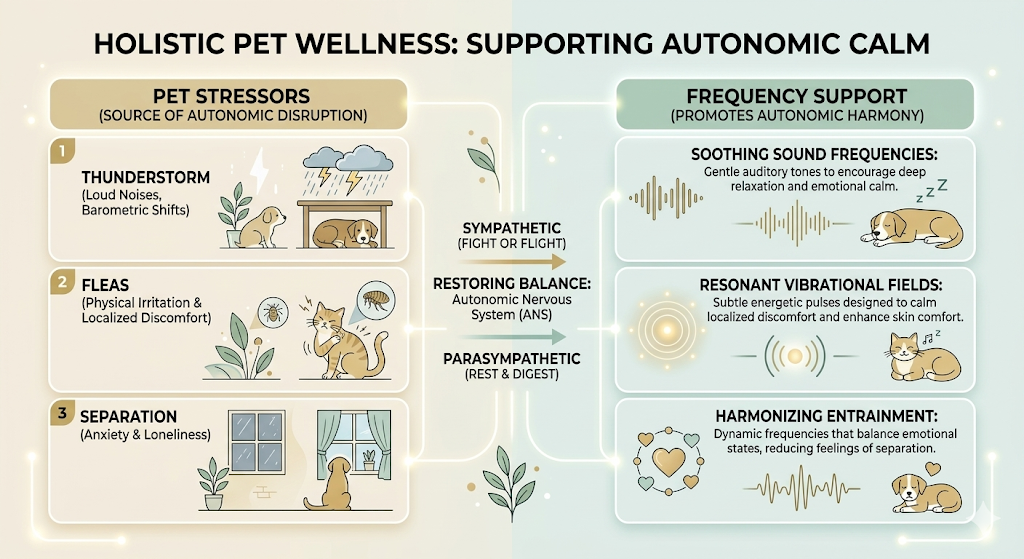
These specialized frequencies are engineered to gently interact with an animal’s biofield and autonomic nervous system. Rather than overriding their biology, sound therapy acts as a gentle guide, designed for:
- Deep Emotional Calming:Restoring peace to overstimulated or fearful nervous systems.
- Daily Stress Support:Buffering the impact of routine disruptions.
- Environmental Comfort:Helping pets feel grounded in unfamiliar settings.
- Comfort Support in Pest-Prone Environments:Soothing the intense nervous tension and physical restlessness associated with seasonal bug irritations.
In short, it is an accessible, supportive practice that helps an animal’s emotional and physiological states return to a natural baseline of homeostasis (Bartel & Mosabbir, 2021).
Why Do Our Pets Need Vibrational Support
Just like humans, our pets absorb the energetic stressors of modern life. However, unlike us, they cannot vocalize their anxiety or choose to remove themselves from a stressful atmosphere, situation, or room.
Common Triggers for Pet Stress
Our animals regularly face a barrage of invisible stressors that disrupt their natural resonance:
- Environmental Turbulence& Pest Stresses:: Loud noises (fireworks, thunder, construction), moving to a new home, or the painful longing of separation anxiety. The physical agony of flea or tick environments. The intense itching leads to a destructive loop of frantic scratching, which spikes their cortisol levels and creates profound emotional distress.
- Telltale Behavioral Cues:When a pet is out of sync, they show it through obsessive licking, constant pacing, erratic vocalizations, or a significant drop in sleep quality.
The Advantage of the "Frequency" Approach
Traditional methods for managing pet stress often involve heavy sedatives or restrictive wearable gear. While those tools have their place, sound therapy offers a beautifully elegant alternative:
- Purely Non-Invasive:There are no pills to hide in food and no uncomfortable wraps to fasten.
- Perfect for Long-Term Wellness:It can be seamlessly integrated into your pet’s lifelong daily routine without side effects.
- Home-Friendly:It transforms your entire living room into a sanctuary of calm.
- Zero Coercion:Your pet remains completely in control, naturally gravitating towards the sound on their own terms.
From a biological standpoint, mammalian brains are highly susceptible to neural entrainment—the process by which brainwaves synchronize with external auditory rhythms (Chaieb et al., 2015). When a stressed animal is immersed in a stable, harmonious frequency, their heart rate and brainwave activity naturally mirror that peace.
How to Use Frequency Support for Your Pets
Implementing sound therapy into your pet’s life requires no technical expertise. You can easily introduce these soothing soundscapes through two primary methods:
Method 1: Ambient Background Audio (For Daily Peace & Maintenance)
This method is perfect for general anxiety maintenance, night-time settling, or smoothing over the transition of moving into a new home.
- Action:Play the designated calming frequency through a standard home speaker at a low, gentle volume.
- Time:Run the track for 20 to 40 minutes per session.
- The Golden Rule:Always allow your pet the freedom to move easily between rooms. If they choose to leave the space, let them; their intuition knows exactly how much resonance they need.
Method 2: Situation-Based (For Stress Spikes & Seasonal Care)
While it may seem novel to use sound therapy for animals, the veterinary community has been observing the benefits of auditory enrichment for years. Pioneering research published in Applied Animal Behaviour Science demonstrated that species-appropriate auditory stimuli can dramatically lower respiratory rates and reduce stress behaviors in domestic animals (Snowdon et al., 2015).
Furthermore, clinical trials evaluating shelter animals have consistently shown that targeted acoustic environments reduce barking, encourage resting behaviors, and lower circulating cortisol levels (Bowman et al., 2017). When we optimize the auditory space, we give our pets the cellular biological quiet they need to activate their own innate healing mechanisms.
Welcome to check out our pet centered FB page for more useful vibrations for our furry friends.
The Science of Happy Tails
Use this approach when your pet is navigating specific hardships, such as high-pest seasons or intense periods of physical scratching and restlessness
Action:Focus the audio directly within your pet’s favorite resting area or kennel.
Time:Use short, frequent bursts—ideally 2 to 3 times a day.
If your pet is agitated due to skin irritations from seasonal bugs, pair the audio session with their regular grooming or environment cleaning routine. The frequency helps lower their emotional reactivity, breaking the anxious “scratch-and-stress” cycle.
A Gentle Invitation to Shared Harmony
At the end of the day, our homes are shared energetic ecosystems. When our pets are anxious, we feel it; when we are stressed, they mirror it. Embracing frequency healing for your pet isn’t just about managing a behavioral symptom, but it is about practicing collective wellness under one roof.
You don’t need to commit to an overhaul of your pet’s life to see a difference. We gently invite you to try a simple, 20-minute ambient listening session during your pet’s next resting period. Turn down the digital noise and turn on a dedicated soothing frequency. Watch closely. You might just find that as your pet’s breathing slows into a rhythm of deep relaxation, your heart also begins to feel centered and peaceful..
References:
- Bartel, L., & Mosabbir, A. (2021). Possible Mechanisms for the Effects of Sound Vibration on Human Health. Healthcare, 9(5), 597.
- Bowman, A., Scottish SPCA, Dowell, F. J., & Evans, N. P. (2017). Four Seasons in an Instant: The effect of music selection on dog behaviour. Physiology & Behavior, 174, 33-43.
- Chaieb, L., Wilpert, E. C., Reber, T. P., & Fell, J. (2015). Auditory Beat Stimulation and its Effects on Cognition and Mood States. Frontiers in Psychiatry, 6, 70.
- Clements-Cortes, A., & Bartel, L. (2018). Vibroacoustic Therapy: Clinical Applications and Research. Journal of Personalized Medicine, 8(4), 40.
- Snowdon, C. T., Teie, D., & Savage, T. (2015). Cats prefer species-appropriate music. Applied Animal Behaviour Science, 166, 106-111.