

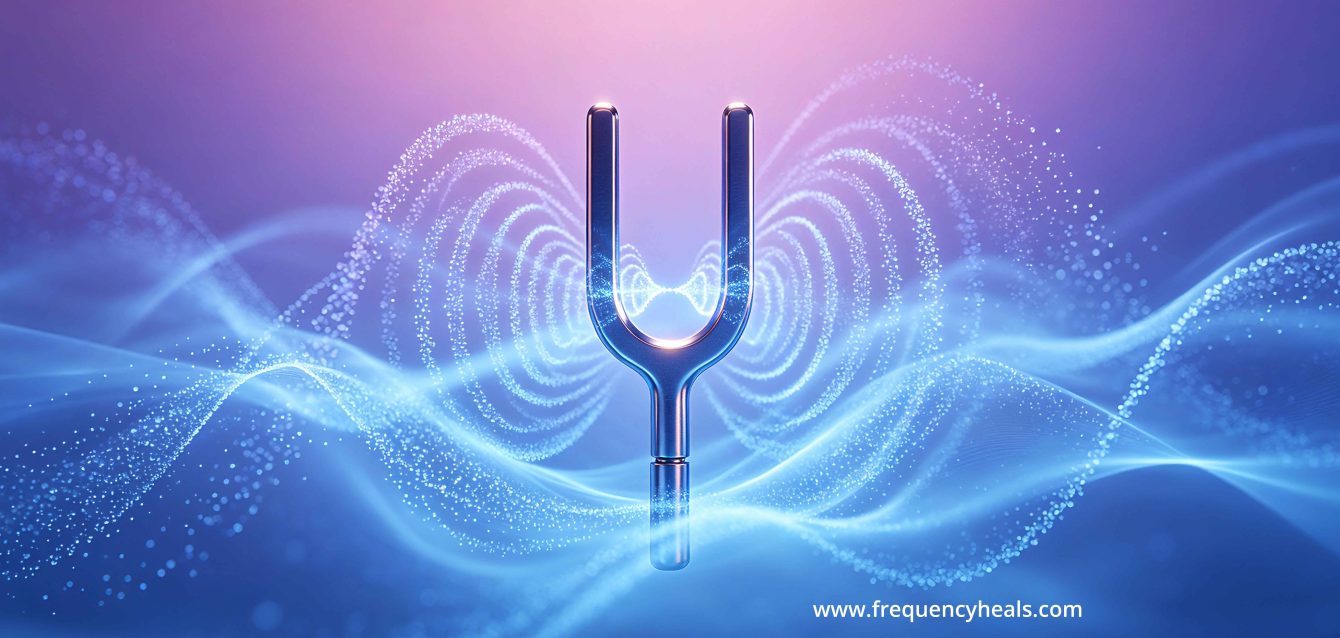
There’s something almost theatrical about a tuning fork. You strike it against your knee — a gentle tap, really — and this plain, unglamorous piece of metal begins to emit a tone so pure and steady that it seems almost out of place in the ordinary world. No strings, no reeds, no breath. Just metal, vibrating.
Tuning forks have been around since 1711, when the British musician John Shore invented them as a reliable pitch reference. For three centuries they’ve been the instrument of choice for piano tuners, musicians, physicians, and physicists. And in that long history, they’ve become perhaps the clearest, most demonstrable illustration of resonance that exists.
I want to use them in this article as a lens — not just to explain what tuning forks do, but to make the physics of resonance feel genuinely tangible. Because once you’ve seen what a tuning fork does to an identical fork across the room, the concept of resonance stops being abstract. It becomes something you feel in your chest.
What a Tuning Fork Actually Is
A tuning fork is a two-pronged metal instrument — the prongs are called tines — precision-machined to vibrate at a single, specific frequency when struck. A fork stamped with ‘440 Hz’ will vibrate at exactly 440 cycles per second, producing the note A4, the standard concert pitch used to tune orchestras worldwide.
The design is elegantly simple. When you strike the tines, they flex inward and outward at their natural resonant frequency — a frequency determined entirely by the fork’s physical properties: the length, thickness, and density of the metal [1]. Because the fork is symmetric and made of a single material, it vibrates cleanly at that one frequency with very little energy lost to other modes of vibration.
This purity is the tuning fork’s great virtue. Most vibrating objects produce a complex mixture of frequencies — the fundamental plus harmonics and overtones. A tuning fork produces essentially one frequency, very nearly a pure sine wave. This makes it an ideal reference standard — and an ideal teaching tool for resonance.
The sound it produces is quiet on its own. But press the handle against a wooden tabletop, and the tone immediately becomes richer and louder. The table is too large and too complex to resonate at a single frequency the way the fork does — but it vibrates sympathetically across a range, amplifying and transmitting the fork’s vibration through a much larger surface area. This is the same principle behind the body of a guitar or violin: mechanical coupling between a precise vibrator and a larger resonating body [1].
The Moment Everything Clicks: Sympathetic Resonance
Here is the demonstration that, in my experience, makes resonance suddenly real for people who’ve only understood it theoretically.
Take two identical tuning forks — both tuned to 440 Hz — and mount them on separate resonance boxes (hollow wooden boxes designed to amplify their vibration). Place them a meter apart, facing each other. Strike one fork and let it ring. Then, after a moment, stop the first fork by pressing your fingers against the tines.
The second fork is still ringing.
You didn’t touch it. You didn’t blow air at it. The only thing that connected the two forks was the sound waves traveling through the air of the room — waves carrying the precise frequency of the first fork’s vibration. And because the second fork’s natural frequency is identical to that of the first, it absorbed that energy efficiently and began vibrating in response [2].
This is sympathetic resonance. The second fork didn’t respond to random noise in the room — to the hum of the refrigerator, the sound of traffic outside, the creak of the floorboards. It responded specifically to the frequency that matched its own natural vibration. Everything else passed through it without effect.
Now try the same experiment with a 441 Hz fork and a 440 Hz fork. The response is dramatically weaker — almost absent at close range, completely absent across a room. One hertz of difference is enough to break the resonant coupling. The selectivity of resonance is not a poetic metaphor. It is a precise physical reality [2].
Why This Demonstrates Resonance So Cleanly
What makes tuning forks such a perfect demonstration tool is that they isolate the key variables.
In most real-world resonance scenarios, there are complicating factors — the driving force changes over time, the resonating system is irregular, the coupling is through a complex medium. Tuning forks cut through all of that. The frequency of the driving signal is known precisely. The natural frequency of the responding system is known precisely. The coupling mechanism — sound waves through air — is simple and well-understood. The outcome is unambiguous [1].
What the demonstration reveals is the three essential conditions for resonance: a system with a well-defined natural frequency, an external signal at or near that frequency, and a coupling mechanism through which the signal can reach the system. When all three conditions are met, energy transfer happens efficiently and the system responds. When any one of them is absent or poorly matched, the response drops off sharply.
These three conditions — natural frequency, matching signal, coupling pathway — turn out to be exactly the same conditions that matter when thinking about how external frequencies might interact with biological systems. More on that shortly.
Why This Demonstrates Resonance So Cleanly
What makes tuning forks such a perfect demonstration tool is that they isolate the key variables.
In most real-world resonance scenarios, there are complicating factors — the driving force changes over time, the resonating system is irregular, the coupling is through a complex medium. Tuning forks cut through all of that. The frequency of the driving signal is known precisely. The natural frequency of the responding system is known precisely. The coupling mechanism — sound waves through air — is simple and well-understood. The outcome is unambiguous [1].
What the demonstration reveals is the three essential conditions for resonance: a system with a well-defined natural frequency, an external signal at or near that frequency, and a coupling mechanism through which the signal can reach the system. When all three conditions are met, energy transfer happens efficiently and the system responds. When any one of them is absent or poorly matched, the response drops off sharply.
These three conditions — natural frequency, matching signal, coupling pathway — turn out to be exactly the same conditions that matter when thinking about how external frequencies might interact with biological systems. More on that shortly.
Tuning Forks in Medicine: An Older Use Than You Might Think
Before we get to the more contemporary applications of resonance in health, it’s worth noting that tuning forks have been clinical instruments for well over a century.
The Rinne test and Weber test, developed in the mid-19th century, use tuning forks to distinguish between two types of hearing loss — conductive (problems in the outer or middle ear) and sensorineural (problems in the inner ear or auditory nerve). The tests work by comparing how well a patient hears a vibrating fork held in the air versus pressed against the bone behind the ear. Bone conduction bypasses the outer and middle ear entirely, transmitting vibration directly to the cochlea. The pattern of responses tells the physician where in the auditory pathway the problem lies [3].
Tuning forks are also used to assess vibratory sensation in peripheral neuropathy — the loss of sensation in the limbs that can accompany diabetes, vitamin deficiencies, and other conditions. A vibrating fork pressed against a bony prominence (a knuckle, an ankle, a toe) should produce a distinct, recognizable sensation. Reduced or absent vibratory sense is an early and sensitive indicator of peripheral nerve damage [3].
These are elegant, low-tech diagnostic tools that have held their place in clinical medicine through generations of technological change. Their durability is a testament to how precisely and reliably they deliver a known, specific frequency.
Tuning Forks in Sound Therapy: What's Actually Being Claimed
In more recent decades, tuning forks have found a place in sound therapy and frequency-based wellness practices. Practitioners use them in various ways — held near the body, placed on specific anatomical points, or used to create audible tones in a therapeutic space.
Some of the claims made in this space are modest and biologically plausible. A vibrating fork placed on a tense muscle group delivers mechanical vibration to the tissue. There is evidence that localized mechanical vibration can reduce muscle tension, stimulate mechanoreceptors, and have analgesic effects through the gate control mechanism of pain modulation [4]. The frequency matters — different frequencies produce different mechanical effects — and the specific forks used by practitioners are often chosen with this in mind.
Other claims move into less well-evidenced territory — that specific frequencies correspond to organs, chakras, or planetary cycles, and that applying these frequencies can directly heal or balance those systems. These claims vary widely in their plausibility. Some rest on analogical reasoning that hasn’t been subjected to rigorous testing. Others are built on preliminary research that is suggestive but not yet conclusive.
The honest position, as with so many things in this field, sits somewhere in the middle. The basic physics is real: a vibrating tuning fork delivers a precise, known frequency to whatever it contacts or whatever airspace surrounds it. The body’s tissues and fluids do transmit mechanical vibration. Biological systems do respond to mechanical and acoustic stimulation in frequency-dependent ways [4]. Whether specific therapeutic protocols using specific frequencies produce the specific clinical outcomes claimed — that’s where the research is still developing, and where appropriate skepticism remains warranted.
The Deeper Lesson the Tuning Fork Teaches
I want to come back to that demonstration — the second fork ringing across the room — because I think it carries a lesson that goes beyond the physics.
The second fork wasn’t passive. It wasn’t waiting to be acted upon by any old force that came along. It had its own nature — its own natural frequency, built into its physical structure — and it responded selectively to the world based on that nature. Everything that didn’t match was ignored. The one thing that did match was received and amplified.
There’s something in this that maps onto biological systems in a way that feels meaningful. Cells, tissues, and organ systems are not blank slates waiting to be programmed by whatever signal arrives. They have their own natural frequencies, their own preferred rhythms, their own intrinsic dynamics. External signals that match those dynamics can influence them. Signals that don’t, largely cannot.
This is why frequency specificity matters so much — in both physics and biology. It’s not enough to apply a vibration or a signal. The question is whether the signal’s frequency matches the natural frequency of the system you’re trying to influence. And that question requires actually knowing both [2].
The tuning fork makes this visible in a way that nothing else quite does. It takes a principle that might otherwise remain abstract — matching frequencies, selective response, energy transfer through resonance — and makes it audible, demonstrable, and undeniable.
A Bridge to What Comes Next
In the next article, we’ll broaden our view considerably — moving beyond acoustic frequencies to map out the full landscape of frequencies that exist in and around us. Sound is just one narrow band in a much wider spectrum.
There are electromagnetic frequencies — from radio waves to visible light to X-rays. There are mechanical frequencies in the infrasound range, below what we can hear but still physically present. There are the slow oscillations of biological rhythms — heartbeats, brainwaves, circadian cycles — operating at frequencies far lower than sound.
Understanding that landscape is the next step toward understanding why frequency-based health practices take so many different forms — and how to think clearly about what each of them is actually doing.
References
- [1] Rossing, T. D. (Ed.). (2007). Springer Handbook of Acoustics. Springer. [Chapter on tuning forks and acoustic resonators]
- [2] Fletcher, N. H., & Rossing, T. D. (1998). The Physics of Musical Instruments (2nd ed.). Springer.
- [3] Bagai, A., Thavendiranathan, P., & Detsky, A. S. (2006). Does this patient have hearing impairment? JAMA, 295(4), 416–428.
- [4] Lundeberg, T., Nordemar, R., & Ottoson, D. (1984). Pain alleviation by vibratory stimulation. Pain, 20(1), 25–44.
- [5] Ganong, W. F. (2005). Review of Medical Physiology (22nd ed.). McGraw-Hill. [Chapters on sensory transduction and mechanoreception]








Comments
Very interesting
Thank you, Pat 😊💙 Glad you found it interesting! Resonance is a fascinating topic, and we’re happy to have you exploring with us 🌿