

We tend to think of frequency as a sound word. You hear a high-pitched tone — high frequency. A deep rumble — low frequency. Frequency, in everyday language, is almost always about sound.
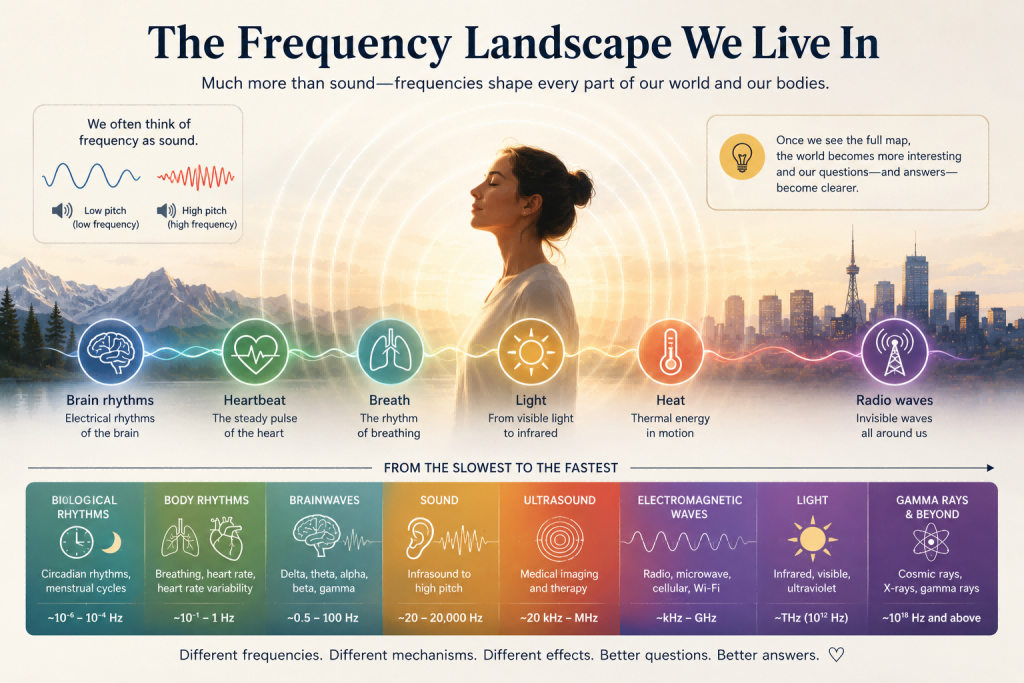
But that’s a little like saying color is about the color red. Sound occupies one narrow slice of a vast and varied frequency landscape that surrounds and permeates us constantly. Understanding what frequency actually means helps put these different forms of waves and oscillations into perspective. Radio waves, light, heat, the electrical rhythms of the brain, the steady pulse of the heart — all of these are, in a precise physical sense, frequencies. Oscillations. Waves repeating at a characteristic rate.
Once you see the full map, two things happen. First, the world becomes more interesting — layered with invisible rhythms you hadn’t thought to notice. Second, the conversation about frequency-based health practices becomes much clearer, because you can place each approach in its proper context and ask more precise questions about what it’s actually doing.
So let’s take a tour. From the slowest biological oscillations to the fastest electromagnetic waves, here is the frequency landscape we live in.
A Quick Note on Units
Before we start, a brief word on how frequency is measured — because the units matter for making sense of the comparisons ahead.
Frequency is measured in hertz (Hz), where one hertz means one complete cycle per second. A heartbeat at rest occurs roughly once per second — about 1 Hz. A concert A note (A4) vibrates at 440 Hz. Your home’s electrical current in North America oscillates at 60 Hz. Visible light oscillates at roughly 400–700 terahertz — that is, 400 to 700 trillion cycles per second [1].
The range is almost incomprehensibly wide. From less than one cycle per day (circadian rhythms) to hundreds of trillions of cycles per second (visible light), the universe operates across more than twenty orders of magnitude of frequency. The human body is active across a surprisingly large portion of that range.
The Slowest Rhythms: Biological Oscillations
At the low end of the frequency spectrum — so slow that we don’t usually think of them as frequencies at all — are the body’s biological rhythms.
The circadian rhythm operates at roughly 0.000012 Hz — one cycle per 24 hours. It’s the master oscillator that coordinates hormone release, body temperature, sleep-wake transitions, immune activity, and the timing of cellular repair processes. This rhythm is entrained primarily by light — specifically, the blue-wavelength light of morning sky, which resets the suprachiasmatic nucleus each day [2].
Slower still are infradian rhythms — biological cycles longer than a day. The human menstrual cycle, at approximately 28 days, is one example. Seasonal mood and energy patterns are another. These ultra-slow oscillations interact with faster bodily rhythms in ways that are still being mapped by chronobiologists [2].
Faster than circadian but still very slow by acoustic standards are ultradian rhythms — cycles shorter than a day but longer than a few minutes. The roughly 90-minute sleep cycle is a well-known example: the brain cycles through light sleep, deep sleep, and REM sleep approximately every 90 minutes throughout the night. There’s evidence that a similar 90-minute oscillation exists during waking hours too, influencing alertness, cognitive performance, and even nostril dominance (which switches in an ultradian rhythm that most people never notice) [2].
The Body's Faster Internal Frequencies
Moving up the frequency scale, we reach the rhythms that clinicians measure routinely — the ones we’ve discussed most directly in this series.
Breathing at rest occurs at roughly 0.2–0.3 Hz — about 12–18 breaths per minute. When deliberately slowed to around 0.1 Hz (five to six breaths per minute), the respiratory system comes into resonance with the natural oscillation frequency of blood pressure regulation, producing the state of cardiovascular coherence we explored in earlier articles [3].
The resting heart rate — around 1 Hz for most adults — is modulated continuously by the autonomic nervous system, producing the beat-to-beat variation we call heart rate variability. HRV itself contains frequency components: the high-frequency band (0.15–0.4 Hz) reflects respiratory influence on the heart via the vagus nerve, while the low-frequency band (0.04–0.15 Hz) reflects a mixture of sympathetic and parasympathetic activity [3].
Brainwaves occupy a range from about 0.5 Hz to 100 Hz, with different frequency bands associated with different states of consciousness. Delta waves (0.5–4 Hz) dominate deep sleep. Theta waves (4–8 Hz) appear during drowsiness and certain meditative states. Alpha waves (8–13 Hz) are prominent during relaxed wakefulness. Beta waves (13–30 Hz) characterize active, engaged thinking. Gamma waves (30–100 Hz) are associated with high-level cognitive processing and perceptual binding [4].
These are not just interesting curiosities about the brain. They’re active areas of research in neuroscience, sleep medicine, and increasingly in frequency-based wellness — because each band reflects a distinct functional state of the nervous system, and because external rhythmic stimuli can influence which band is dominant.
Sound: The Familiar Middle Ground
The human auditory range spans roughly 20 Hz to 20,000 Hz — a frequency range we perceive as sound. Within this band, different frequencies carry different qualities and associations.
Infrasound sits below 20 Hz — too low to hear, but not too low to feel. Frequencies in the range of 7–19 Hz can induce subtle vibrations in body cavities and tissues. There’s intriguing research suggesting that low-level infrasound from wind turbines may contribute to the discomfort reported by some nearby residents, though the mechanisms and dose-response relationships are still being worked out [1]. Some researchers have proposed that infrasound in the 18–19 Hz range can produce unease, even mild visual disturbances — possibly because the resonant frequency of the human eyeball is in this range, though this specific claim remains speculative.
Within the audible range, specific frequencies have been studied for their physiological and psychological effects. Low frequencies (20–250 Hz) are felt as much as heard — experienced as vibration in the chest and body. Mid-range frequencies carry much of the information in speech. Higher frequencies in the 2–4 kHz range fall within the most sensitive zone of human hearing, which is also the range of infant crying and many alarm signals — likely not coincidentally [1].
Ultrasound sits above 20,000 Hz — too high for human hearing. Medical ultrasound imaging typically operates in the 2–18 MHz range. Therapeutic ultrasound, used in physiotherapy to promote tissue healing and reduce inflammation, typically operates at 1–3 MHz. The mechanisms involve both thermal effects (localized heating) and non-thermal effects (acoustic streaming and cavitation at the cellular level) [5].
Electromagnetic Frequencies: A Vast and Varied Spectrum
Beyond mechanical sound waves lies the electromagnetic spectrum — a range of wave frequencies that don’t require a physical medium to travel through, and that carry both energy and information across vast distances.
At the low end are extremely low frequency (ELF) electromagnetic fields — below 300 Hz. The Earth’s natural electromagnetic environment includes the Schumann resonances, a set of electromagnetic resonances in the cavity between the Earth’s surface and the ionosphere. The fundamental Schumann frequency is approximately 7.83 Hz — a number that has attracted considerable interest in wellness circles because it sits within the alpha/theta brainwave range [4]. The biological significance of Schumann resonances, if any, is genuinely debated, with some researchers proposing that living organisms may have evolved sensitivity to these fields, and others finding the proposed mechanisms implausible at typical exposure levels.
Radio waves occupy the range from a few kilohertz to several gigahertz. They carry FM and AM broadcasts, Wi-Fi signals, mobile phone communications, and GPS signals. The body is largely transparent to these frequencies at typical environmental levels — they pass through without significant interaction. At very high intensities (as in some industrial equipment), radio-frequency fields can produce thermal effects, but everyday environmental exposure is many orders of magnitude below those levels [1].
Microwaves (gigahertz range) are efficiently absorbed by water molecules — which is why microwave ovens work. They are also the frequencies used in mobile communications and some medical imaging technologies. The health effects of chronic low-level microwave exposure remain an active area of study, with regulatory agencies maintaining exposure limits based on thermal effects while research into non-thermal effects continues [1].
Infrared radiation sits just below visible light in frequency — we perceive it as heat. The body both emits and absorbs infrared radiation continuously. Infrared saunas and therapeutic infrared lamps operate in this range. There is reasonable evidence that near-infrared wavelengths can penetrate tissue and influence mitochondrial function through the same photobiomodulation pathways discussed in earlier articles [5].
Visible light occupies an extraordinarily narrow slice of the electromagnetic spectrum — roughly 400 to 700 nanometers in wavelength, corresponding to about 430–770 terahertz in frequency. Within that narrow band, wavelength determines color: violet at the high end, red at the low end. Light is the most biologically important of all electromagnetic frequencies for most organisms, driving photosynthesis, vision, and circadian entrainment through specialized light-sensitive proteins [2].
Above visible light lie ultraviolet (UV), X-rays, and gamma rays — progressively higher-energy electromagnetic radiation. UV light drives vitamin D synthesis in skin and can damage DNA at higher exposures. X-rays and gamma rays carry enough energy to ionize atoms and are used diagnostically and therapeutically in medicine, but require careful management of exposure because of their tissue-damaging potential [1].
Pulsed Electromagnetic Fields: A Therapeutic Application
One category worth particular attention in the context of frequency-based health practices is pulsed electromagnetic field (PEMF) therapy, which uses electromagnetic pulses at specific frequencies — typically in the ELF to radio-frequency range — delivered to tissues for therapeutic purposes.
PEMF devices have been used in bone healing for several decades, with regulatory approval for certain indications. The proposed mechanisms involve electromagnetic induction of weak electrical currents in tissue, which appear to stimulate osteoblast activity and enhance bone repair [5]. More recently, PEMF has been studied for applications in pain management, wound healing, and inflammation reduction, with a growing but still somewhat mixed evidence base.
What makes PEMF interesting from a frequency-biology perspective is that the effects appear to be frequency-dependent — different frequencies producing different biological responses at the cellular level — which is consistent with the resonance principles we’ve been building throughout this series. The body’s cells and tissues are not uniformly responsive to all electromagnetic frequencies. They respond selectively, and matching the frequency to the biological process you’re trying to influence appears to matter [5].
Holding the Full Picture
Stepping back from the tour, what strikes me most is the sheer range of frequencies at which the body is both active and responsive. From the once-per-day oscillation of the circadian system to the trillions-of-cycles-per-second of visible light interacting with the eye — the human organism is a frequency-responsive system across an enormous span.
Different frequency-based health practices are intervening at very different points on this spectrum, through very different physical mechanisms. Sound therapy works through mechanical vibration in the acoustic range. PEMF works through electromagnetic induction at very low frequencies. Photobiomodulation works through light in the infrared and visible range. Each has its own physics, its own biological targets, its own evidence base.
Treating them as a single undifferentiated category — as either all valid or all invalid — misses the specificity that matters. The more useful question is always: what frequency, delivered how, to which biological system, producing what measurable effect, for which conditions? That’s the question the better research in this field is beginning to answer.
In the articles ahead, we’ll start moving toward those specific answers — looking at individual therapeutic modalities with the same grounded, curious lens we’ve been using throughout this series.
References
- [1] Pozar, D. M. (2011). Microwave Engineering (4th ed.). Wiley. [Background on electromagnetic spectrum and frequency classification]
- [2] Reppert, S. M., & Weaver, D. R. (2002). Coordination of circadian timing in mammals. Nature, 418(6901), 935–941.
- [3] Shaffer, F., & Ginsberg, J. P. (2017). An overview of heart rate variability metrics and norms. Frontiers in Public Health, 5, 258.
- [4] Buzsáki, G., & Draguhn, A. (2004). Neuronal oscillations in cortical networks. Science, 304(5679), 1926–1929.
- [5] Pilla, A. A. (2013). Nonthermal electromagnetic fields: From first messenger to therapeutic applications. Electromagnetic Biology and Medicine, 32(2), 123–136.







Comments
Thank you, for the Very necessary information regarding healing.
Hi Susan 💜
Thank you so much for your kind words. 😊
We’re happy to hear that you found the information helpful. We’ll continue sharing more educational content about frequencies and wellness.
Thank you for being part of our community, and we wish you all the best on your journey. 💙✨